

Explained
How to Detect Shadow AI in Your Organization
Shadow AI breaches average $4.63M. Here is how to detect shadow AI using DNS logs, OAuth audits, and your endpoint inventory, step by step.
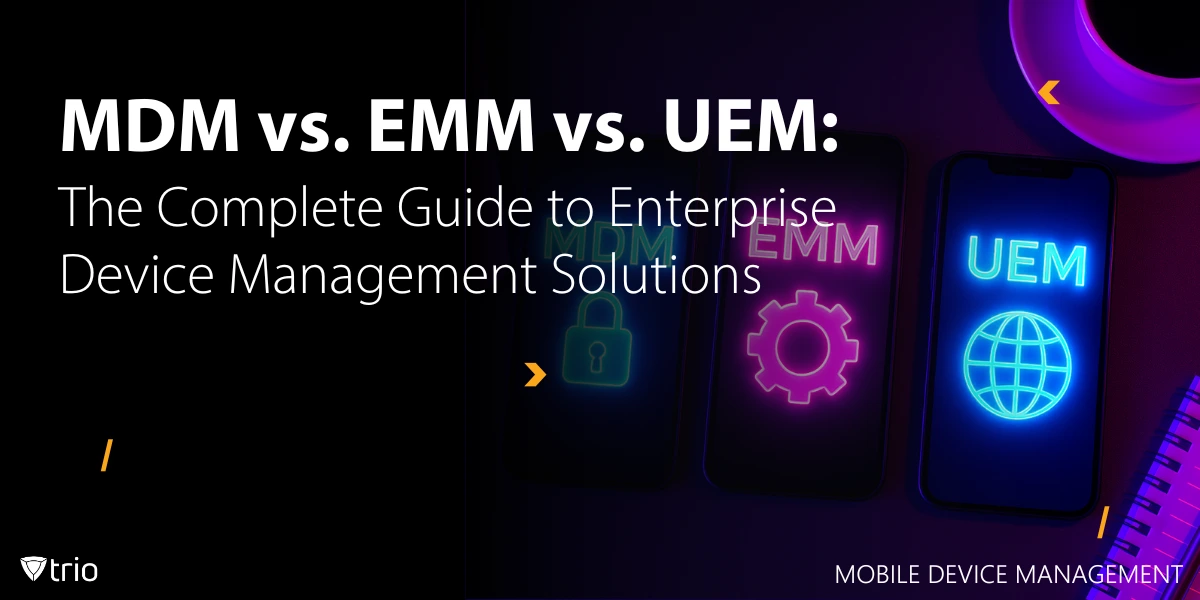
Compare MDM vs. EMM vs. UEM solutions for enterprise device management. Learn key differences, costs, and when to choose each approach in 2025.
In the era of hybrid workforces, BYOD policies, and sprawling digital ecosystems, protecting your data starts with something deceptively simple: managing your devices. The challenge? Today's organizations face an unprecedented explosion of endpoints. Your data travels on smartphones in coffee shops, tablets in airports, and laptops on kitchen tables. Choosing between MDM vs. EMM vs. UEM isn't just about features – it's about survival in 2025's threat landscape. With over 80% of organizations now using BYOD policies and cyber threats evolving daily, the wrong choice can expose your entire network through a single compromised device.
Understanding what MDM is and why organizations initially embraced it reveals the foundation of modern device security. The difference between MDM EMM and UEM lies in their scope and capabilities, making this choice critical for any best endpoint management strategy.
Core MDM capabilities:
Ideal when:
EMM adds three layers atop MDM:
Ideal when:
UEM unifies all endpoints under one pane:

This comprehensive mobile device security comparison reveals the distinct capabilities of each approach:
| Capability | MDM | EMM | UEM |
|---|---|---|---|
| Device Support | Mobile only | Mobile + basic desktop | All endpoints (mobile, desktop, IoT) |
| App Management | Basic app deployment | Containerized MAM | Full-lifecycle app management |
| Content Management | Limited file control | Secure containers (MCM) | Enterprise content management |
| Identity & Access | Device-based auth | IAM + SSO/MFA | Comprehensive identity governance |
| BYOD Readiness | Basic personal support | Strong BYOD capabilities | Advanced BYOD/CYOD |
| Security Scope | Device-level | App & data-level | Endpoint-to-cloud |
| Automation | Policy pushes | Workflow automation | AI-driven playbooks |
| Analytics | Device health metrics | User behavior analytics | Full endpoint analytics |
| Compliance | Basic reporting | Industry-specific templates | Enterprise-wide governance |
The decision between MDM vs. EMM vs. UEM depends on your organization's specific context and growth trajectory.
Small retail chains, local service businesses, and startups often find MDM sufficient for their immediate needs. An MDM strategy works when device diversity is low and security requirements are straightforward. Healthcare organizations handling HIPAA data, financial services managing customer information, and consulting firms with extensive travel requirements typically benefit from EMM's advanced capabilities. Large enterprises, technology companies, and organizations with complex IT environments find UEM's unified approach essential for operational efficiency and security effectiveness.
Successful mobile device management implementation requires careful planning, regardless of which solution you choose.
The threat landscape continues evolving, making endpoint security more critical than ever. According to Grand View Research, the global enterprise mobility management market size was estimated at $19.05 billion in 2024 and is projected to grow at a CAGR of 24.1% from 2025 to 2030, driven by significant increases in mobile devices and organizations' focus on protecting their digital infrastructure. Modern attacks target the weakest endpoint in your network. A compromised personal device accessing corporate email can provide attackers with network access, credential theft opportunities, and data exfiltration paths. Advanced solutions must address these evolving threats through:

The financial implications of MDM vs. EMM vs. UEM extend beyond licensing costs. Consider these factors: Direct costs include:
Hidden costs often include:
Cost savings realized through:
Calculate total cost of ownership over three years rather than focusing on initial implementation costs. UEM solutions often provide better long-term value despite higher upfront investments.
Technology trends shaping the future of endpoint management include artificial intelligence automation, edge computing integration, and quantum-resistant security protocols. Your chosen solution should demonstrate clear development roadmaps addressing these emerging requirements. Consider how your organization will evolve over the next five years. Will you add IoT devices? Expand internationally? Adopt new work models? Your device management platform should scale with your growth rather than requiring replacement. Integration capabilities become increasingly important as organizations adopt cloud-first strategies. Ensure your solution provides robust APIs for connecting with existing tools and future technology investments.
The difference between MDM vs. EMM vs. UEM ultimately comes down to scope, complexity, and future requirements. Start by assessing your current device ecosystem, security requirements, and growth projections. MDM provides essential mobile device security for organizations with straightforward requirements. EMM adds the application and content management necessary for BYOD environments and compliance-driven industries. UEM offers comprehensive endpoint management for complex, hybrid organizations requiring unified security across all device types. Rather than choosing based on current needs alone, consider where your organization will be in three years. The cost of migrating between platforms often exceeds the investment in a more comprehensive solution from the start.
This section explores endpoint management strategies categorized by their architectural focus—MDM, EMM, or UEM—highlighting technical features.
Mobile Device Management (MDM) solutions lay the groundwork for securing and controlling mobile endpoints, with features tailored to OS-level oversight and device state enforcement.
Keeping operating systems and third-party apps up to date is fundamental. A robust MDM should offer:
Automating patch cycles shrinks the attack surface by ensuring known vulnerabilities are remediated within policy SLAs.
In retail, healthcare, logistics, and hospitality, locked-down devices provide consistency and security. Kiosk mode features include:
Kiosk-managed endpoints (POS terminals, digital signage, check-in kiosks) maintain a deterministic state and dramatically reduce user errors and tampering.
Enterprise Mobility Management (EMM) expands on MDM by introducing app-level security controls and flexible data protection strategies within corporate environments.
At the heart of EMM, secure containers wrap corporate apps and data:
Beyond remote wipe, modern EMM enforces:
Critical for GDPR, HIPAA, and PCI-governed organizations where a single leak can incur six-figure fines.
Unified Endpoint Management (UEM) blends MDM and EMM with broader infrastructure integration, supporting desktops, mobile, IoT, and identity-driven access.
Extend endpoint management onto the network:
Tying device posture to network policies ensures all traffic passes through corporate inspection points.
A UEM-IAM marriage enables:
Used together, endpoint posture signals become the final gatekeeper for sensitive resources.
Today’s UEM must speak dozens of “dialects”:
Ideal for manufacturing floors, utilities, and smart-building deployments.
Scale security operations via:
Automated pipelines codify best practices, reducing manual effort and human error.
The evolution from MDM to EMM to UEM reflects the changing nature of work itself. As device diversity increases and security threats evolve, organizations need management solutions that can adapt and scale. Key takeaways for your decision:
Your device management strategy directly impacts both security posture and employee productivity. Choose a solution that aligns with your organization's current needs while providing a clear path for future growth. Ready to implement a comprehensive endpoint management solution that scales with your organization? Free demo to see how Trio's unified endpoint management platform can simplify your device management while strengthening security across all endpoints.
Every organization today needs a solution to automate time-consuming tasks and strengthen security. Without the right tools, manual processes drain resources and leave gaps in protection. Trio MDM is designed to solve this problem, automating key tasks, boosting security, and ensuring compliance with ease.
Every organization today needs a solution to automate time-consuming tasks and strengthen security. Without the right tools, manual processes drain resources and leave gaps in protection. Trio MDM is designed to solve this problem, automating key tasks, boosting security, and ensuring compliance with ease.





Have questions? We've got answers. This section covers some of the most commonly asked questions related to this topic.
Related
The related industry news, interviews, technologies, and resources.
Shadow AI breaches average $4.63M. Here is how to detect shadow AI using DNS logs, OAuth audits, and your endpoint inventory, step by step.
Declarative device management is Apple's answer to MDM polling delays and unreliable compliance data — here's how it works and how to start using it.
An APNS certificate is what lets your MDM platform send commands to iPhones, iPads, and Macs — here's how to create, renew, and protect it.
Device location history works differently on Android, iPhone, and MDM platforms. Here's what each one actually stores and how to access it.
Unlike full-device VPN, per-app VPN tunnels only the apps you choose — and without MDM enforcement, users can bypass it entirely on unmanaged devices.
A remote wipe on a Mac is only possible if the right tools are in place first — here is how MDM, Find My, and native macOS each handle device erasure.
Compare SOC 2 Type 1 and Type 2 audits. Discover key differences, audit scope, duration, and how to choose for compliance needs.
Compare managed and unmanaged devices - definitions, security differences, control levels, and how to choose the right approach for IT.