

Product Updates
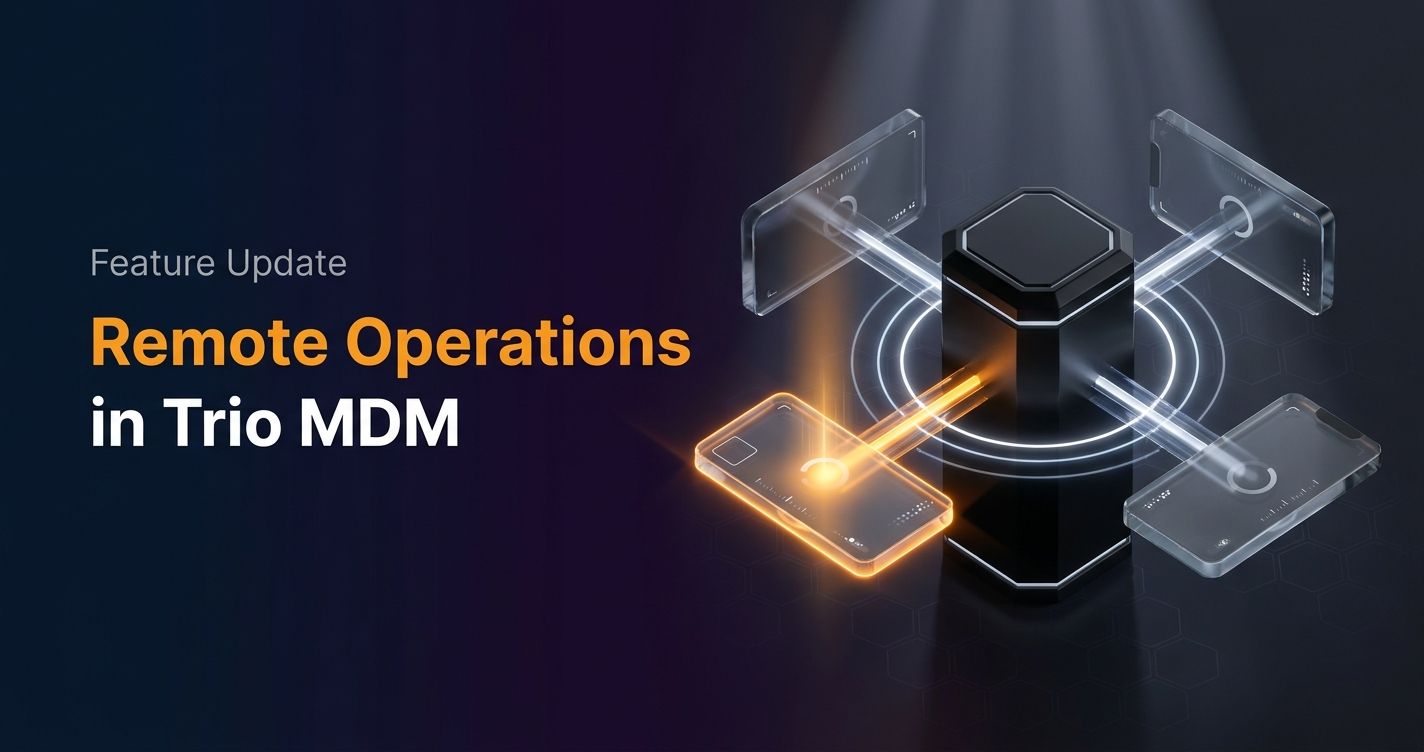
Remote Operations Update Is Live in Trio MDM
Trio MDM launches a brand new Remote Operations - remotely execute scripts, deploy commands, and automate device management at enterprise scale.
Trio V2 is live at console.trio.so. See what you can use today, the rule the new console is built on, and what is coming next: risk-based patching, compliance evidence, automations and AI assistants.
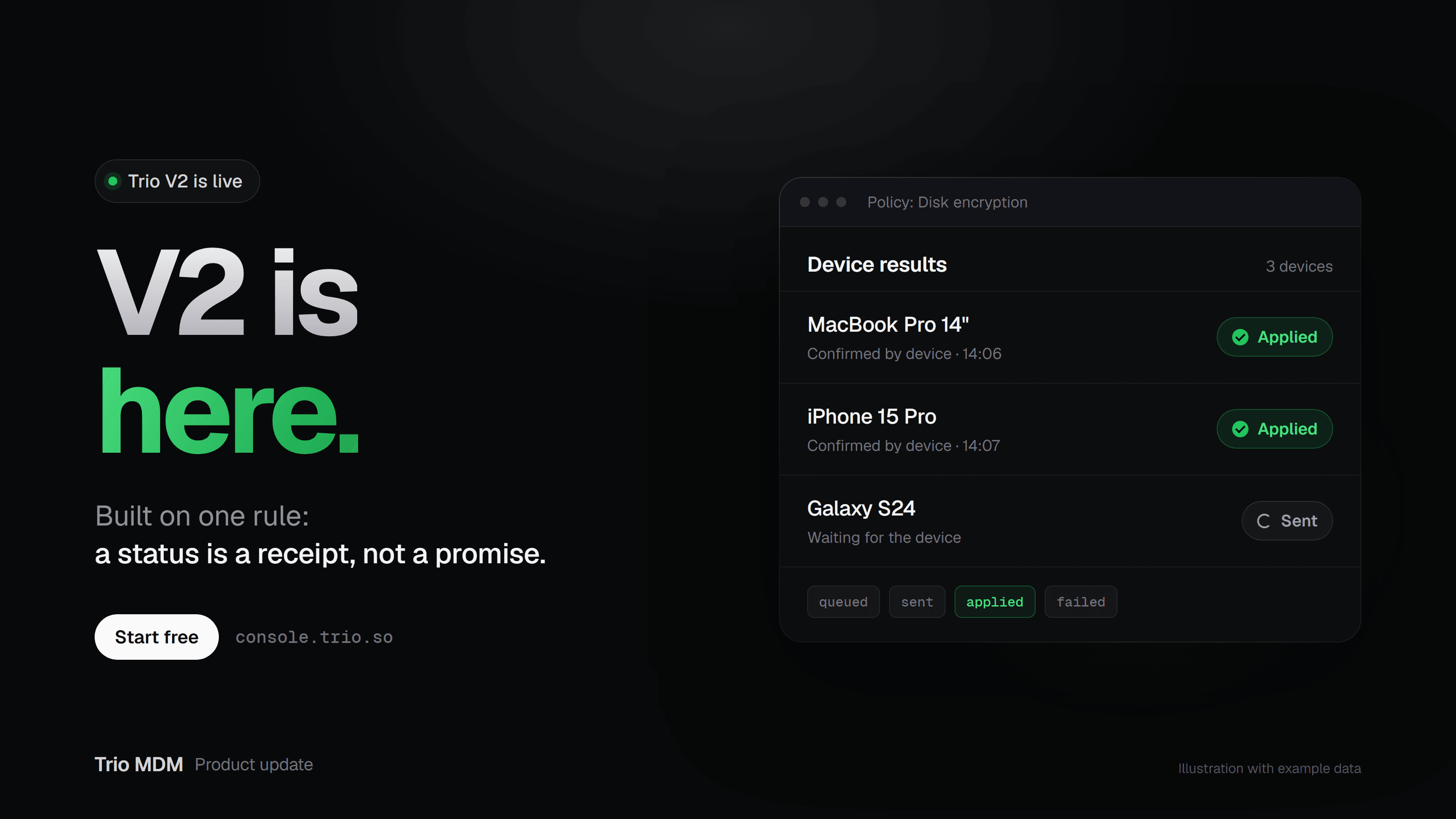
Trio MDM has a new foundation. Trio V2 is live at console.trio.so, with a rebuilt console, a faster way in, and a clear rule behind every screen: if Trio shows you a result, the device has confirmed it.
This post covers what you can use today, what is rolling into V2 next, and what we are still building. We have labeled each part plainly, because a product update should tell you what is real.
Most device management dashboards show a green tick when a command has been sent. Sent is something the server knows. Applied is something only the device can confirm. Those are two different facts, and the gap between them usually stays hidden until an auditor, an incident or a lost laptop makes somebody check.
For an IT team of one to ten people, that gap is the whole job. You are the person who answers the auditor, the finance lead and the employee whose laptop was stolen. "We sent the lock command" is not an answer. "The device confirmed it was locked at 14:06" is.
So V2 starts from one rule: a status is a receipt, not a promise. Everything else is built on top of it.
V2 runs in a new console. Sign-up is one field and a verification email, and a working workspace takes about two minutes. Every paid plan comes with a 14-day free trial.
A command moves through four states: queued, sent, applied and failed. Only one of those is something the device vouches for. V2 is designed to show all four in plain words, without opening a log. Pending is an honest state, not something to hide, and a setting that did not apply should tell you which device and why.
The week before an audit is when most IT teams find out what they cannot prove. V2 treats evidence as a by-product of normal work: policy changes, exceptions and device results are recorded as they happen, so you export them instead of rebuilding them.
We are opening Trio to AI assistants through the Model Context Protocol (MCP), so the tools your team already uses can ask questions about your fleet with the same permissions and the same audit trail as a person.
These are in design or in build. We will announce each one here when it ships, and not before.
A list of four thousand CVEs tells you nothing. V2 scores each finding from 0 to 100 using CVSS, the likelihood of exploitation (EPSS), the CISA list of known exploited vulnerabilities, how critical the device is and how exposed it is. Anything already being exploited goes to the top.
Each device is checked against the controls that matter: disk encryption, firewall, screen lock, anti-malware and patch level. Exceptions are recorded with a reason, an approver and an end date, and the evidence exports for your auditor.
Pick a ready-made fix, choose the devices, and see exactly which ones it will touch before anything runs. Only approved templates, never free scripts. Risky changes need a second person to approve. A run counts as done only when Trio has checked the device is actually fixed.
Connect Claude, ChatGPT or Copilot to Trio through the Trio MCP server and ask about your fleet in plain language: "Which laptops have not checked in this week, and who uses them?" The first release is read only. An assistant can look before it can touch anything.
Each client keeps its own Apple, Microsoft and Google accounts and its own boundary, and your team works across all of them from one console. See the MSP page for the details.
We will not show you a result we cannot back up. That applies to the console, and it applies to this blog. When a feature above moves from coming to live, you will read it here first.
Trio V2 is live now. Setup takes about two minutes and the trial is free for 14 days.
Start your free trial or book a demo and bring your messiest device problem with you.
Every organization today needs a solution to automate time-consuming tasks and strengthen security. Without the right tools, manual processes drain resources and leave gaps in protection. Trio MDM is designed to solve this problem, automating key tasks, boosting security, and ensuring compliance with ease.
Every organization today needs a solution to automate time-consuming tasks and strengthen security. Without the right tools, manual processes drain resources and leave gaps in protection. Trio MDM is designed to solve this problem, automating key tasks, boosting security, and ensuring compliance with ease.





About Trio free trials.
Related
The related industry news, interviews, technologies, and resources.
Trio MDM launches a brand new Remote Operations - remotely execute scripts, deploy commands, and automate device management at enterprise scale.
As Linux becomes the top malware target, a lack of enterprise device management tools leaves these new endpoints exposed and non-compliant.
Enhance Apple Business Manager with Trio for seamless device management, improved workflows, and top-notch security.
Stay connected with Trio’s Slack integration—real-time alerts for security, device, and authentication updates, all in your favorite collaboration tool.
Read more on how Trio Education can create a productive learning environment by simplifying classroom device management.

With great pride, we at SternX announce that our MDM software, Trio, has recently achieved the prestigious NIST 800-171 certification.

Trio MDM is now HIPAA certified, providing enhanced data security and privacy for healthcare organizations. Learn more.
Trio achieves CCPA certification, enhancing data privacy standards and boosting customer trust in their technology solutions.