



Explained
Bulk Deployment: Revolutionizing Device Provisioning
Here’s a guide to bulk deployment, a game-changing approach that revolutionizes how organizations manage their device ecosystems.
What laptop management software does, MDM for Windows and Mac laptops, remote staff, a step-by-step fleet plan and what to look for in a tool.

Content writer, trio.so
Laptop management software lets IT set up, secure, update and support every company laptop from one console, wherever the laptop is. It enrolls each Windows PC, Mac or Linux laptop, applies security settings such as disk encryption and screen lock, keeps the operating system and apps patched, installs the software each role needs, opens remote support sessions, and can wipe a lost or returned laptop. Today most of this is done with a mobile device management (MDM) or unified endpoint management (UEM) tool, which manages laptops the same way it manages phones.
If you look after the Windows and Mac laptops of a 20 to 300 person company, often for people who work from home, this guide explains what laptop management covers, how MDM handles laptops compared with older tools, and gives you a step-by-step plan for your fleet.
Laptop device management is the day-to-day work of keeping company laptops set up correctly, secure and supported, from the day they arrive to the day they leave the company. Laptops are harder to manage than office desktops because they move: they connect from homes, hotels and coffee shops, rarely sit on the office network and are easier to lose.
Until recently, company laptops were managed with tools built for office networks: Group Policy for Windows settings, a disk image copied onto every new machine, and on-premises tools such as Configuration Manager. Those still work on the office network, but they struggle with laptops that rarely come in.
Windows 10 and later, and macOS, include built-in management interfaces that an MDM can use over the internet. That changed laptop management in three ways:
Very little today. Most tools sold as "laptop management software" are MDM or UEM tools that manage laptops along with phones and tablets. The difference worth checking is depth on laptops: patching of third-party apps, software deployment, encryption and remote support are laptop jobs that a phone-focused MDM may handle poorly.
| Task | Windows laptops | Mac laptops |
|---|---|---|
| Automatic enrollment | Windows Autopilot, or Entra join with automatic MDM enrollment | Automated Device Enrollment through Apple Business |
| Disk encryption | BitLocker | FileVault |
| OS updates | Windows Update policies: deferral, deadlines, active hours | Apple's declarative software update management with target version and deadline |
| App deployment | MSI packages and store apps | DMG packages and App Store apps bought through Apple Business |
| Remote support | Remote desktop | Screen sharing or remote desktop |
For more on each side, see BitLocker drive encryption, patch management for Windows, macOS patch management and remote access for Mac.
trio.so enrolls Windows laptops through Windows Autopilot and Macs through Apple Business, enforces BitLocker and FileVault encryption, and keeps BitLocker recovery keys in the console. Operating system updates run through Auto Patch policies and third-party fixes through remediation plans, IT can open a remote desktop or terminal session from the console, and a company laptop can be wiped remotely. Linux laptops sit in the same console with core policies. Plans start at $5 per device.
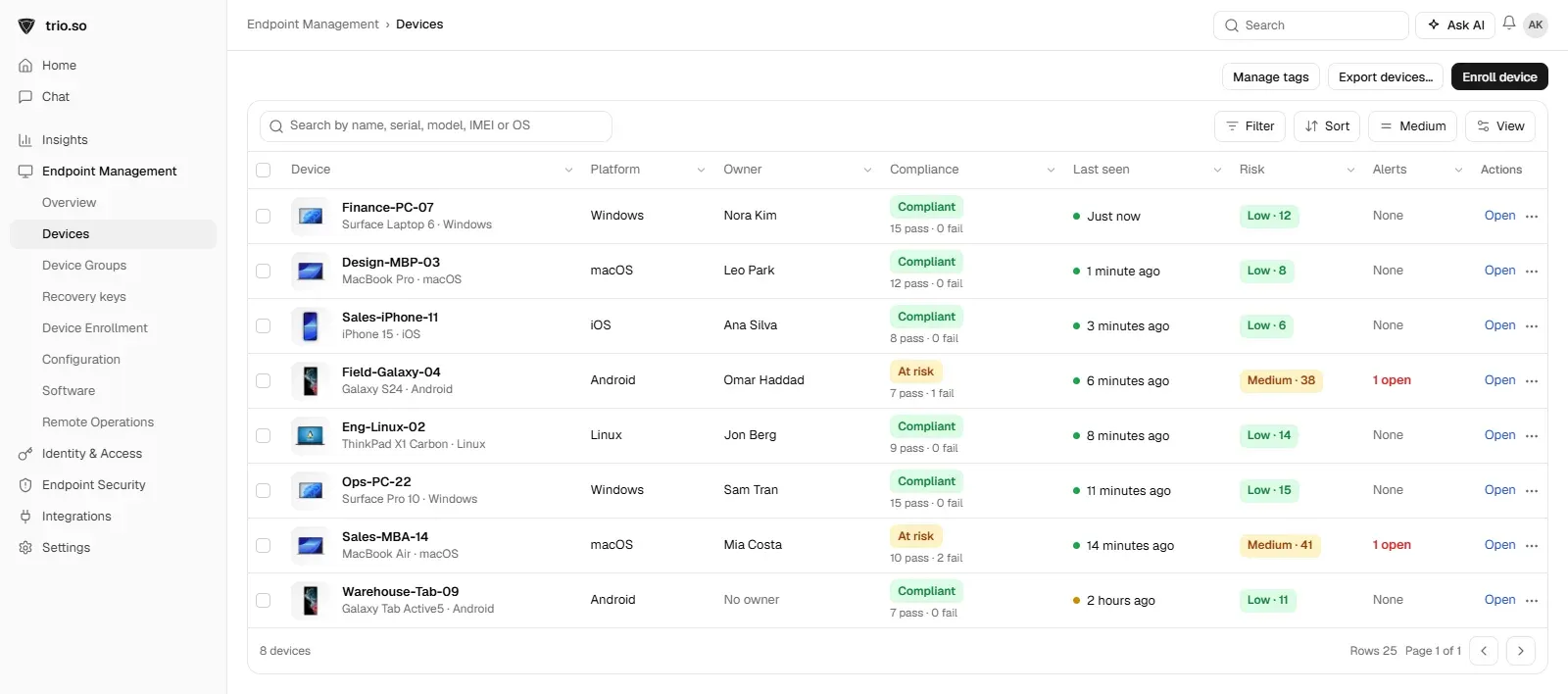
Software that lets IT enroll, secure, update and support company laptops from one console: encryption, updates, apps, remote support, inventory and remote wipe.
Yes. Windows and macOS include management interfaces that MDM tools use over the internet, so the same MDM can manage laptops, desktops and phones.
Standardise models, enroll every laptop automatically, apply one security baseline, patch on a schedule with deadlines, keep the inventory current and wipe every laptop when its user leaves.
Mostly the name. Most laptop management tools are MDM or UEM tools; check how deep they go on laptop jobs such as third-party patching, software deployment and remote support.
Ship laptops that enroll themselves at first sign-in, manage them from a cloud console, support them with remote desktop and wipe them remotely if they are not returned.
Related reading: device lifecycle management, device inventory management and Windows device enrollment.
trio.so enrolls Windows and Mac laptops automatically, keeps them updated and opens a remote session from the console.
trio.so brings device management, patching and security policies for Windows, macOS, Linux, iOS/iPadOS and Android into one console. Enroll a device and see it in the console within minutes.
trio.so brings device management, patching and security policies for Windows, macOS, Linux, iOS/iPadOS and Android into one console. Enroll a device and see it in the console within minutes.





Have questions? We've got answers. This section covers some of the most commonly asked questions related to this topic.
Related
The related industry news, interviews, technologies, and resources.
Here’s a guide to bulk deployment, a game-changing approach that revolutionizes how organizations manage their device ecosystems.
Discover the transformative shift from Mobile Device Management to Modern MDMs. What’s the difference and what’s best for your organization?

Can MDM track your location? What IT can see on company phones and laptops, what a work profile hides, how geofencing works, and the privacy rules.
MDM vs. MAM, which one should you choose for your company's mobile security? Read about their benefits and key differences here.
Device provisioning for employee laptops and phones: zero-touch with Apple Business, Windows Autopilot and Android Enterprise, a checklist, and fixes.
How to implement mobile device management in phases: scope, policies, enrollment per platform, pilot, communication and rollout, with a 30/60/90-day plan.
An effective MDM strategy can improve an organization. Read on to learn how Mobile Device Management solutions can help you.
A mobile device management policy sets the governance rules for device use, security, and enforcement, here is how to structure one that works.
14-day free trial. No credit card required.
trio.so for MSPs: one console, separate clients