



MSP
Co-Managed IT: How Internal IT and an MSP Share One Console
Co-managed IT explained: who does what, how to split roles between internal IT and an MSP, and how to give both access to one device console.
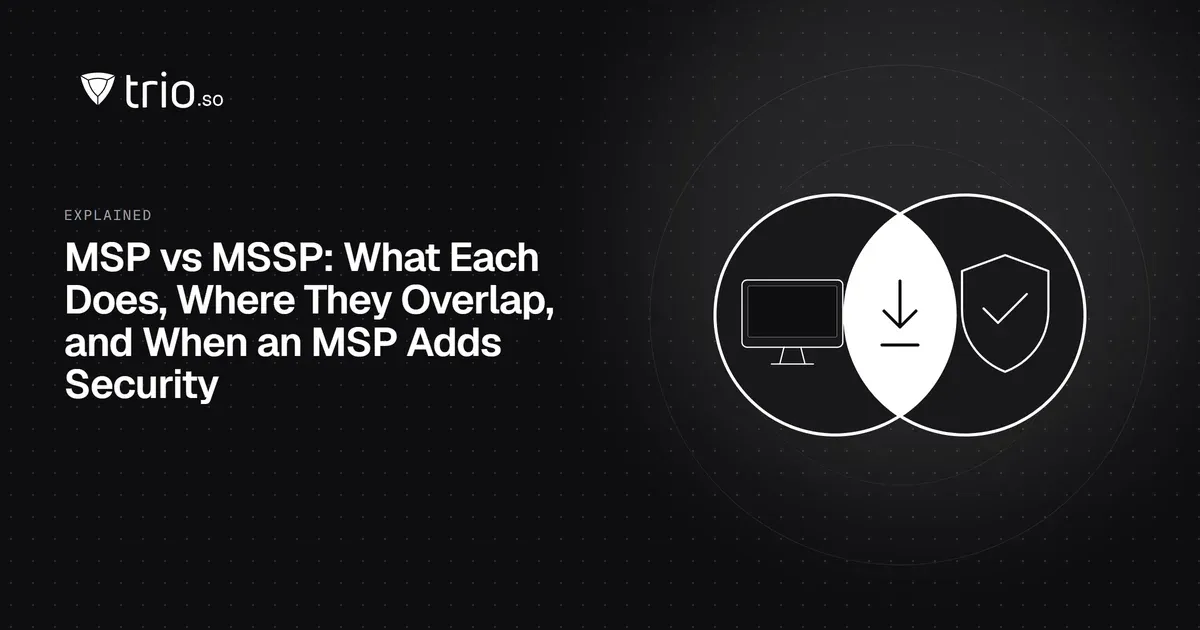
MSP vs MSSP in plain terms: what each delivers, where patching and endpoint security overlap, and when an MSP should partner for MDR or build.

Content writer, trio.so
An MSP runs a client's everyday IT. An MSSP does security work only. A managed service provider (MSP) handles devices (endpoints), users, updates, help desk and backup. A managed security service provider (MSSP) monitors for threats, investigates alerts and helps with incident response. The two overlap on patching, endpoint protection and compliance evidence, and many clients end up using both.
If you run an MSP and a client keeps asking about security, the sections on overlap and on adding security are written for you.
MSP. An MSP keeps a client's technology running for a recurring fee. It enrolls and updates devices, manages accounts, answers tickets and watches uptime. Rapid7 describes the MSP as operations-led: the job is to keep devices, networks and applications running so people can work. Security is part of the job, usually at a baseline level.
MSSP. An MSSP is security-led. It collects security data, triages alerts, investigates what looks malicious and supports the response when something is. The work usually runs from a security operations center (SOC), often with staff on shift around the clock. For the full definition, see our guide to managed security service providers. For the MSP side, see our guide to managed IT services.
| MSP | MSSP | |
|---|---|---|
| Main job | Keep IT running and supported | Detect, investigate and respond to security threats |
| Typical services | Help desk, device management, patching, backup, user accounts, cloud administration | Threat monitoring, alert triage, vulnerability scanning, incident response, compliance reporting |
| Tools | RMM (remote monitoring and management), UEM or MDM (device management for laptops and phones), PSA (professional services automation), backup, documentation | SIEM (security event log analysis), EDR (endpoint detection and response, software on each device that spots and reports attacks), threat intelligence, vulnerability scanners |
| Staffing | Technicians, often working from a network operations center (NOC) | Security analysts, working from a SOC |
| Pricing | Monthly fee, per device, per user or a bundle | Usually priced by monitored endpoints, users or log volume, plus incident response fees (varies by provider) |
| Service levels | Response and resolution times for tickets | Time to review and escalate an alert, and who owns the response |
Sources: Kaseya, "MSP vs MSSP: What's the Difference?" (24 November 2021); CrowdStrike, "MSP vs. MSSP: Understanding the Difference" (15 June 2023); Rapid7, "MSP vs. MSSP: Key Differences Explained" (undated). The pricing and service level rows for MSSPs are our summary of how providers commonly quote, not a figure from those pages. Vendors that sell security tools wrote all three sources.
Rapid7 puts it plainly: the two "can overlap, but they aren't interchangeable." Three areas are shared.
The practical point for the client is who owns each step. If an MSSP flags a laptop and the MSP has to fix it, both contracts should say who calls whom, and how fast.
Many MSPs start adding security because clients ask for it, because cyber insurance questionnaires demand it, or because a client has an incident. There are three ways to do it, and they are not exclusive.
Staffing decides which route is realistic. ISC2's 2024 Cybersecurity Workforce Study, which surveyed 15,852 practitioners and decision-makers in April and May 2024, estimated a global gap of 4.8 million security professionals, up 19% on the year before. The gap is the number of security professionals the market needs minus the number who exist, not a count of open jobs. That shortage is why small MSPs partner instead of hiring.
A sensible order for most MSPs: get the endpoint layer solid first, then partner for monitoring, then decide whether volume justifies building. Do not sell "security monitoring" until someone is contractually watching alerts.
trio.so is a device management console for MSPs. For the security work that sits on devices, it gives you one console for several client companies, with each client's devices, users and policies kept separate. It shows patch findings for each device. Each finding carries CVSS (severity), EPSS (chance of exploitation) and CISA KEV status (whether the flaw is on the US government list of vulnerabilities attackers are known to exploit).
trio.so handles OS updates through Auto Patch policies and fixes for third-party software (apps that are not part of the operating system) through remediation plans, and shows the result for each device. It exports compliance evidence, including a Patch Audit Trail. It also pulls each device's Microsoft Defender for Endpoint status and open alerts into the trio.so device record.
trio.so is not an EDR and does not replace an MSSP's detection and response. When an MSSP flags a device, the MSP can act on it from trio.so. See trio.so for MSPs for details. Plans start at $5 per device on the pricing page.
Every organization today needs a solution to automate time-consuming tasks and strengthen security. Without the right tools, manual processes drain resources and leave gaps in protection. trio.so is designed to solve this problem, automating key tasks, boosting security, and ensuring compliance with ease.
Every organization today needs a solution to automate time-consuming tasks and strengthen security. Without the right tools, manual processes drain resources and leave gaps in protection. trio.so is designed to solve this problem, automating key tasks, boosting security, and ensuring compliance with ease.





Related
The related industry news, interviews, technologies, and resources.
Co-managed IT explained: who does what, how to split roles between internal IT and an MSP, and how to give both access to one device console.
The MSP software stack by job in 2026: RMM, PSA, MDM, patching, backup, security. What each covers, where RMM stops, and how to evaluate.
What is an MSP? A managed service provider runs a business's IT for a monthly fee. Here is what MSPs do, how they charge and how to choose one.
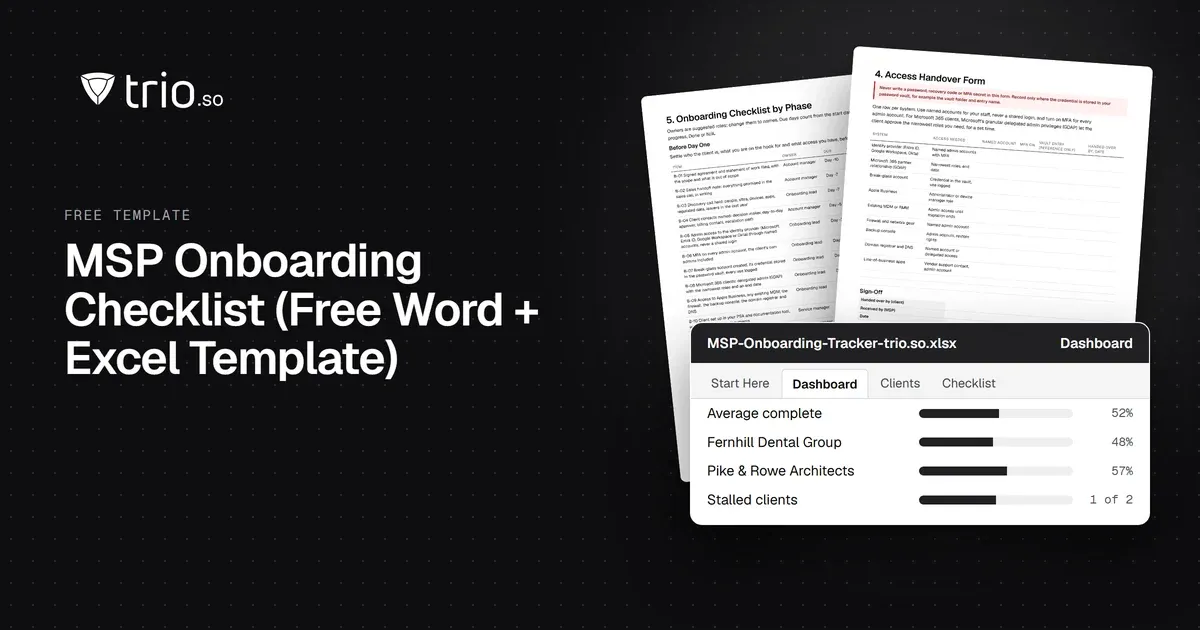
Free MSP onboarding checklist in Word, Excel and PDF: access handover, inventory, enrollment, baseline policies, a security check and offboarding.
NIS2 covers managed service providers across the EU. See when it applies to your MSP, what Germany's law says, and what clients will ask you to show.
The MSP security stack in 2026: the layers to cover, the tool category in each, and what clients now expect you to show. Start with endpoints and identity.
Best RMM software for MSPs in 2026, compared on multi-tenancy, Mac and Linux coverage, patching, remote access and pricing.
14-day free trial. No credit card required.
trio.so for MSPs: one console, separate clients