



MSP
The MSP Security Stack in 2026: Layers, Tools and What Clients Expect
The MSP security stack in 2026: the layers to cover, the tool category in each, and what clients now expect you to show. Start with endpoints and identity.
NIS2 covers managed service providers across the EU. See when it applies to your MSP, what Germany's law says, and what clients will ask you to show.

Content writer, trio.so
Yes. The EU directive lists managed service providers (MSPs) and managed security service providers (MSSPs) as covered entity types, and whether your company is covered directly depends on its size and on the member state where it is based. If you are not covered yourself, your regulated clients probably are, and they will start asking what you can show them.
This post is for MSP owners and IT service companies in or selling into the EU. It explains what is law and what is client expectation, uses Germany as the worked example, and ends with where trio.so helps with the device side of the evidence.
NIS2 is Directive (EU) 2022/2555. A directive is not law by itself. Each member state writes its own national law from it, so registration, deadlines and fines differ by country. The directive names "ICT service management (business to business)" as a sector, and that sector includes managed service providers and managed security service providers. Size matters too. Under the directive's size rule, a company in a listed sector is in scope if it has 50 or more staff, or if its annual turnover and its balance sheet each exceed €10 million. The EU's definition of company size (Recommendation 2003/361/EC) sets the tests, and the staff and revenue of linked or partner companies can be added to yours.
Which country's law applies to you depends on the member state where your company has its main establishment, usually your headquarters. If you provide managed IT services under contract, you almost certainly count as a managed service provider, and size then decides whether the rules reach you. Your lawyer confirms the edge cases.
Source: Directive (EU) 2022/2555, Articles 2, 26 and Annex I (EUR-Lex, read 12 November 2026).
Germany transposed NIS2 in its amended BSI Act (BSIG). Secondary sources, including the law firms Heuking and usd, report that it came into force on 6 December 2025 with no grace period before the duties applied, though registration had its own three-month window. Annex 1 of the BSIG lists "Managed Services Provider" (no. 6.1.10) and "Managed Security Services Provider" (no. 6.1.11) under the sector digital infrastructure. Section 28 sets a headcount test and a financial test.
Germany's size tests (section 28 BSIG):
| Class | Threshold under section 28 BSIG |
|---|---|
| Essential entity | 250 or more staff, or (more than €50 million turnover and more than €43 million balance sheet) |
| Important entity | 50 or more staff, or (more than €10 million turnover and more than €10 million balance sheet) |
In the table above, meeting the first row makes you an essential entity; meeting only the second makes you an important entity. Essential entities face stricter supervision than important ones.
Source: BSIG section 28 (gesetze-im-internet.de, read 4 November 2026).
A service company with 30 employees is unlikely to reach these thresholds on its own, but group structures and holdings can count, so check before you rely on it.
Covered entities had to register with the Federal Office for Information Security (BSI) within three months of the law taking effect, so by early March 2026 for existing entities (section 33 BSIG). That deadline has passed. If you are covered and have not registered, do it now. In Germany the BSI portal needs an organization certificate from ELSTER, the German tax authority's online portal. It works as a digital company ID, and you request it there. Other member states set their own dates and procedures.
For covered entities, the directive asks for appropriate and proportionate technical and organizational risk measures, and German law repeats this in section 30 BSIG. The law lists minimum measures. Four of them sit close to daily MSP work.
Incident reporting comes with deadlines. For a significant incident, the directive and section 32 BSIG set an early warning within 24 hours of becoming aware, a fuller notification within 72 hours, and a final report one month after the 72-hour notification. Management must approve and oversee the measures and complete training (section 38 BSIG).
Fines are set nationally. In Germany section 65 BSIG sets maximums of €10 million for essential and €7 million for important entities, or 2% and 1.4% of worldwide annual turnover respectively, whichever is higher. These match the minimum maximums the directive sets in Article 34.
A separate EU regulation (2024/2690) adds more detailed technical rules for MSPs and MSSPs on top of NIS2; ask your counsel which parts apply. For a checklist, see our NIS2 compliance checklist. If you run a security-focused service, our post on managed security service providers covers that provider type.
Covered clients must look at the security of their own supply chain. An IT provider with administrator access to their systems is part of that chain, so expect questions in contracts and audits. The law does not give a fixed list for providers, so these are typical questions, not legal requirements:
trio.so lets an MSP manage several client companies in one console, with each client's devices, users and policies kept separate. It finds open vulnerabilities on managed devices and gives each device a risk score from 0 to 100. CVSS and EPSS score how severe a vulnerability is and how likely it is to be exploited. CISA KEV lists vulnerabilities already exploited in attacks. You can sort findings by urgency with all three. Auto Patch policies handle operating system updates, and for third-party software trio.so builds remediation plans, each a written, step by step plan for closing a vulnerability in that software. The patch audit trail can be exported as evidence. No tool makes you NIS2 compliant, because that depends on how you run your whole business: policies, people, suppliers and incident handling. trio.so gives you the device and patch data that risk management needs. Plans start at $5 per device. Read more about trio.so for MSPs and MSSPs.
This post is not legal advice. Directive checked at EUR-Lex on 12 November 2026; German law (BSIG) checked on 4 November 2026.
Every organization today needs a solution to automate time-consuming tasks and strengthen security. Without the right tools, manual processes drain resources and leave gaps in protection. trio.so is designed to solve this problem, automating key tasks, boosting security, and ensuring compliance with ease.
Every organization today needs a solution to automate time-consuming tasks and strengthen security. Without the right tools, manual processes drain resources and leave gaps in protection. trio.so is designed to solve this problem, automating key tasks, boosting security, and ensuring compliance with ease.





Related
The related industry news, interviews, technologies, and resources.
The MSP security stack in 2026: the layers to cover, the tool category in each, and what clients now expect you to show. Start with endpoints and identity.
Best RMM software for MSPs in 2026, compared on multi-tenancy, Mac and Linux coverage, patching, remote access and pricing.
MSP vs MSSP in plain terms: what each delivers, where patching and endpoint security overlap, and when an MSP should partner for MDR or build.
Co-managed IT explained: who does what, how to split roles between internal IT and an MSP, and how to give both access to one device console.
The MSP software stack by job in 2026: RMM, PSA, MDM, patching, backup, security. What each covers, where RMM stops, and how to evaluate.
What is an MSP? A managed service provider runs a business's IT for a monthly fee. Here is what MSPs do, how they charge and how to choose one.
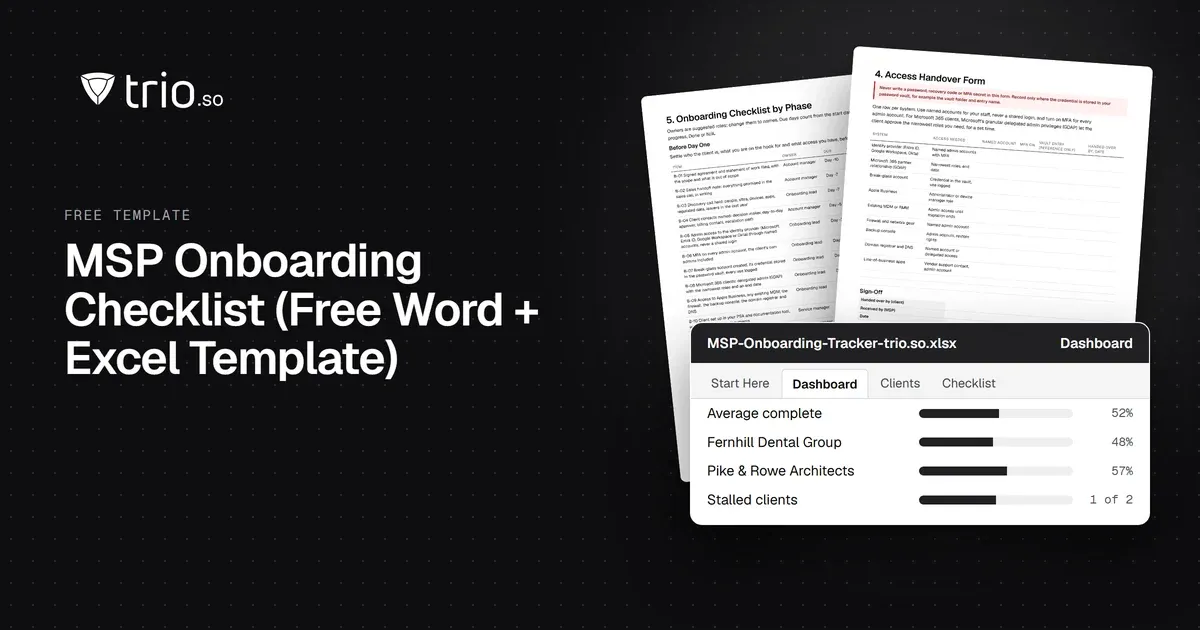
Free MSP onboarding checklist in Word, Excel and PDF: access handover, inventory, enrollment, baseline policies, a security check and offboarding.
14-day free trial. No credit card required.
trio.so for MSPs: one console, separate clients