



Templates
Mobile App Security Policy Template (Free Word + Excel)
Free mobile app security policy in Word and PDF: approved app sources, app vetting, blocked apps and permissions, plus an Excel app register.
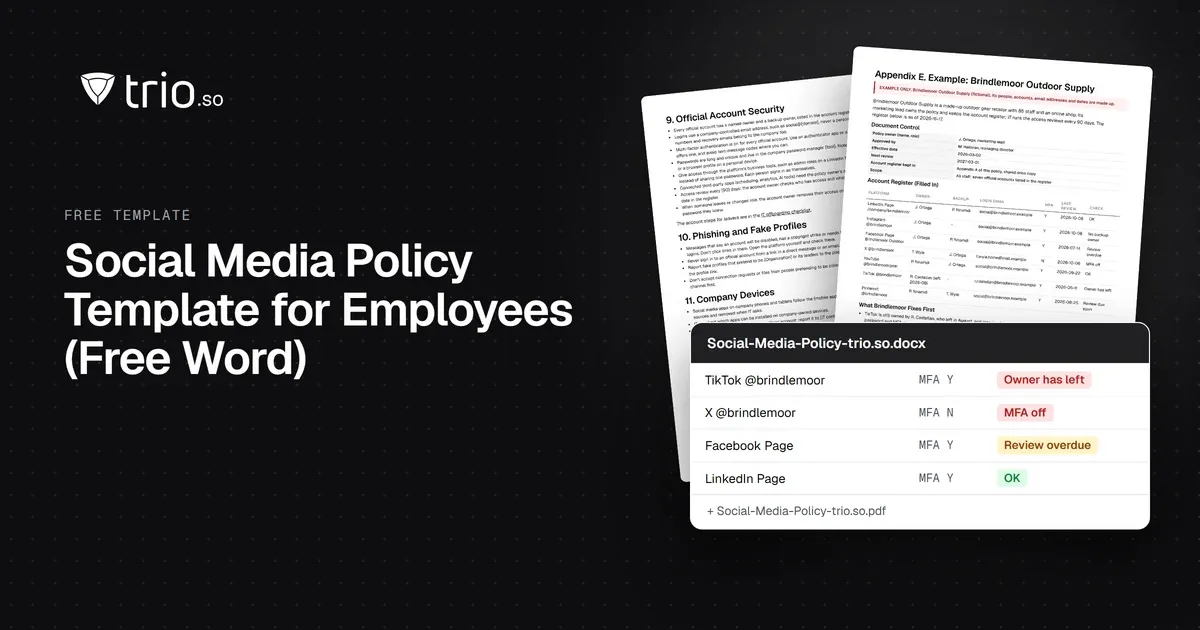
Free social media policy template for employees in Word and PDF: personal and official accounts, account security and a hacked-account checklist.

Content writer, trio.so
Most companies write a social media policy after something goes wrong: a customer's order details in an employee's post, a fake profile using the CEO's photo, or the company Instagram that nobody can get into because the only login belonged to someone who left last year. A written policy deals with all three. It tells staff what they can post on their own accounts, who speaks for the company, and how the company's own accounts stay under company control.
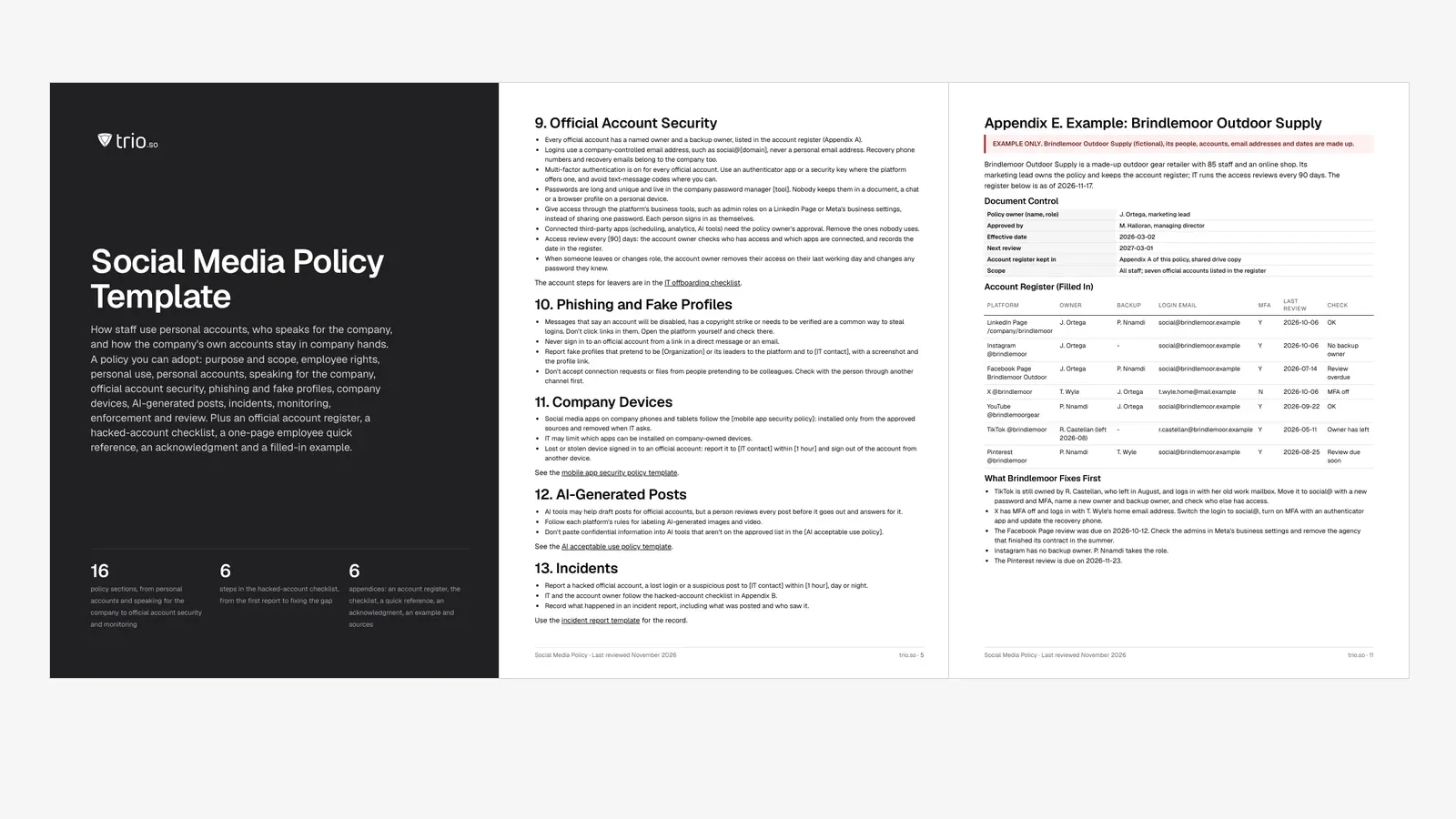
This template is written for small and mid-sized companies, for HR, marketing and IT to adopt together. The download is a Word policy with fillable fields and the same policy as a PDF. It includes an official account register, a hacked-account checklist, a one-page employee quick reference, an acknowledgment and a filled-in example for a made-up retailer.
In short
The policy covers two things that often end up in separate documents: how employees behave on social media, and how the company secures the accounts it owns. The second part is what people mean by a social media security policy.
| Section | What it settles |
|---|---|
| Scope, definitions and roles | Who is covered, what counts as an official account, and who owns the policy, the accounts and the response to a hack |
| Your rights | A plain statement that employees may discuss pay and working conditions |
| Personal use and personal accounts | Breaks, disclosure when posting about products, confidential information, harassment |
| Speaking for the company | Authorized spokespeople, approvals, press questions and crisis replies |
| Official account security | Owners, company login email, MFA, password manager, access reviews, offboarding |
| Phishing, devices and AI | Fake profiles, login phishing, social apps on company phones, AI-written posts |
| Incidents, monitoring, enforcement | Hacked accounts, the company's monitoring choice, discipline and review |
In the US, Section 7 of the National Labor Relations Act protects employees who talk with each other about pay, hours and working conditions, and that includes posts and comments on social media. It applies to most private-sector employers, whether or not they have a union. Broad rules such as "don't say anything negative about the company online" or "never discuss internal matters" are the kind that get challenged.
The National Labor Relations Board's current test comes from Stericycle (2023). If a rule could reasonably make employees hesitate to use those rights, it is presumed unlawful, and the employer has to show a legitimate and substantial business interest that a narrower rule couldn't protect. As of November 2026 Stericycle is still the Board's standard, although the NLRB General Counsel listed it in a 2026 memo among the decisions she wants the Board to revisit. The template handles this in two ways: section 5 says plainly what employees may discuss, and every rule names a specific harm, such as customer data, harassment or speaking for the company. A rights statement doesn't fix a rule that is too broad, so have employment counsel read the final version.
Other countries have their own rules. In the EU, monitoring employees, including their social media, falls under the GDPR, and in countries with works councils, such as Germany, the council usually has a say. The template doesn't give legal advice for any country.
Employees' own accounts are theirs. The policy only steps in when a post involves the company:
The disclosure rule follows the FTC Endorsement Guides: the FTC asks employees who mention their employer's products to disclose the relationship in the post itself, not only on their profile.
Write the holding statement in advance: two sentences that say the company knows, is looking into it and will post an update. Then the account owner doesn't have to improvise while a post is spreading.
Company accounts get lost in boring ways. The login runs through someone's personal email, MFA was never turned on, or the person who set up the account left and took the recovery phone with them. Section 9 of the policy closes those gaps:
The account register in Appendix A holds the facts for each account: platform, handle, owner, backup owner, login email, whether MFA is on and the date of the last access review. When someone leaves, the IT offboarding checklist covers their other accounts; the register shows which social accounts they could get into.
A common way to steal a social media login is a message: a direct message or email saying the page will be disabled, has a copyright complaint or needs to be verified, with a link to a fake login page. The policy tells staff never to sign in from such a link and to check inside the platform instead. Fake profiles that pretend to be the company or its leaders are reported to the platform and to IT with a screenshot and the profile link.
If an account is taken over anyway, the checklist in Appendix B sets the order of work:
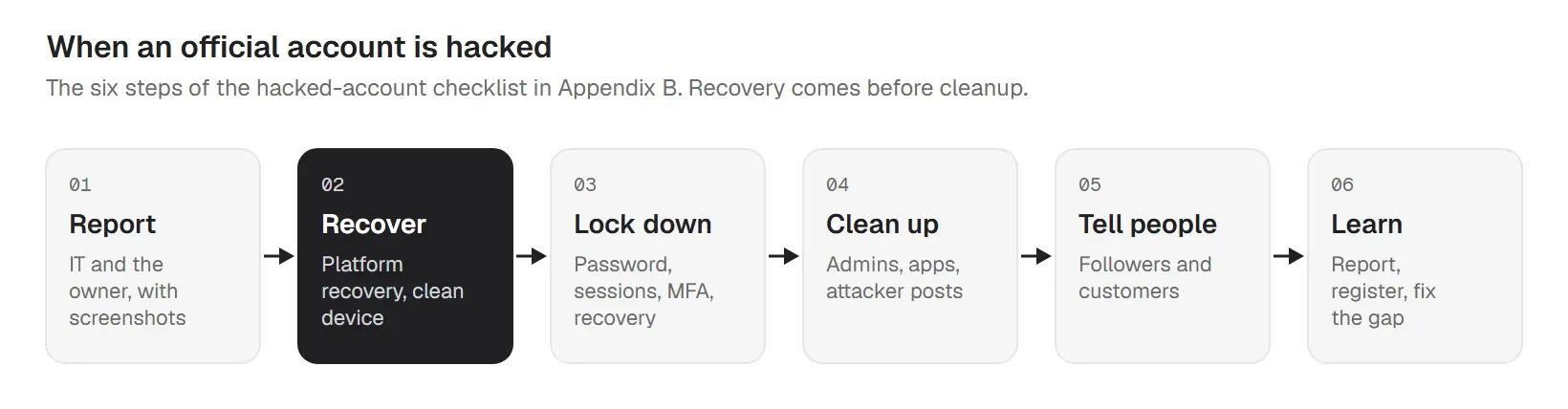
Recovery comes first, because you can't remove the attacker's posts or admins until you have the account back. Record the case in an incident report so the gap that let the attacker in gets fixed.
Social apps on company phones and tablets follow your mobile app security policy: installed from approved sources and removed when IT asks. If you decide some apps don't belong on company Android phones, our guide on how to block an app on Android shows the options. General rules for company IT stay in your acceptable use policy.
AI tools can draft posts for official accounts, but a person reviews each post before it goes out, follows the platform's rules for labeling AI images and video, and keeps confidential data out of tools that aren't on the approved list in your AI acceptable use policy.
Settle the monitoring section with counsel. The template offers two options: the company doesn't monitor personal accounts, or it reviews public posts that mention it by name to find brand mentions, fake profiles and security issues. Either way, it never asks for passwords to personal accounts; many US states bar employers from asking for them.
Appendix C turns the policy into a one-page list for everyone:
The download includes a filled-in register for Brindlemoor Outdoor Supply, a made-up outdoor gear retailer with 85 staff. On 17 November 2026 it ran 7 official accounts, and 4 of them had a problem to fix:
| Account | Owner | MFA | Last review | Check |
|---|---|---|---|---|
| LinkedIn Page /company/brindlemoor | J. Ortega | Y | 2026-10-06 | OK |
| Instagram @brindlemoor | J. Ortega | Y | 2026-10-06 | No backup owner |
| Facebook Page Brindlemoor Outdoor | J. Ortega | Y | 2026-07-14 | Review overdue |
| X @brindlemoor | T. Wyle | N | 2026-10-06 | MFA off |
| YouTube @brindlemoorgear | P. Nnamdi | Y | 2026-09-22 | OK |
| TikTok @brindlemoor | R. Castellan (left 2026-08) | Y | 2026-05-11 | Owner has left |
| Pinterest @brindlemoor | P. Nnamdi | Y | 2026-08-25 | Review due soon |
Its TikTok account still belongs to an employee who left in August, X has MFA off and logs in with a home email address, the Facebook Page review is a month late, and Instagram has no backup owner. The company, people and addresses are made up.
trio.so doesn't monitor social media, read posts or messages, or filter websites. It manages the devices where social apps and business accounts live. For the devices behind this policy, trio.so gives you:
Removing someone's access to a social platform, setting up MFA on an official account and deciding what to post stay with the account owner and this policy. trio.so manages Windows, macOS, Linux, iOS/iPadOS and Android from one console. Plans start at $5 per device.
14-day free trial. No credit card required.
Sources. Last reviewed November 2026. References are short pointers to the NLRB's Stericycle decision and the FTC Endorsement Guides. The wording is ours. trio.so is not affiliated with or endorsed by the NLRB or the FTC. This post is not legal advice.
trio.so doesn't monitor social media. It lists the apps on company devices, blocks app installs on company Android phones and supervised iPhones, and wipes a lost company-owned phone.
trio.so brings device management, patching and security policies for Windows, macOS, Linux, iOS/iPadOS and Android into one console. Enroll a device and see it in the console within minutes.
trio.so brings device management, patching and security policies for Windows, macOS, Linux, iOS/iPadOS and Android into one console. Enroll a device and see it in the console within minutes.





Have questions? We've got answers. This section covers some of the most commonly asked questions related to this topic.
Related
The related industry news, interviews, technologies, and resources.
Free mobile app security policy in Word and PDF: approved app sources, app vetting, blocked apps and permissions, plus an Excel app register.
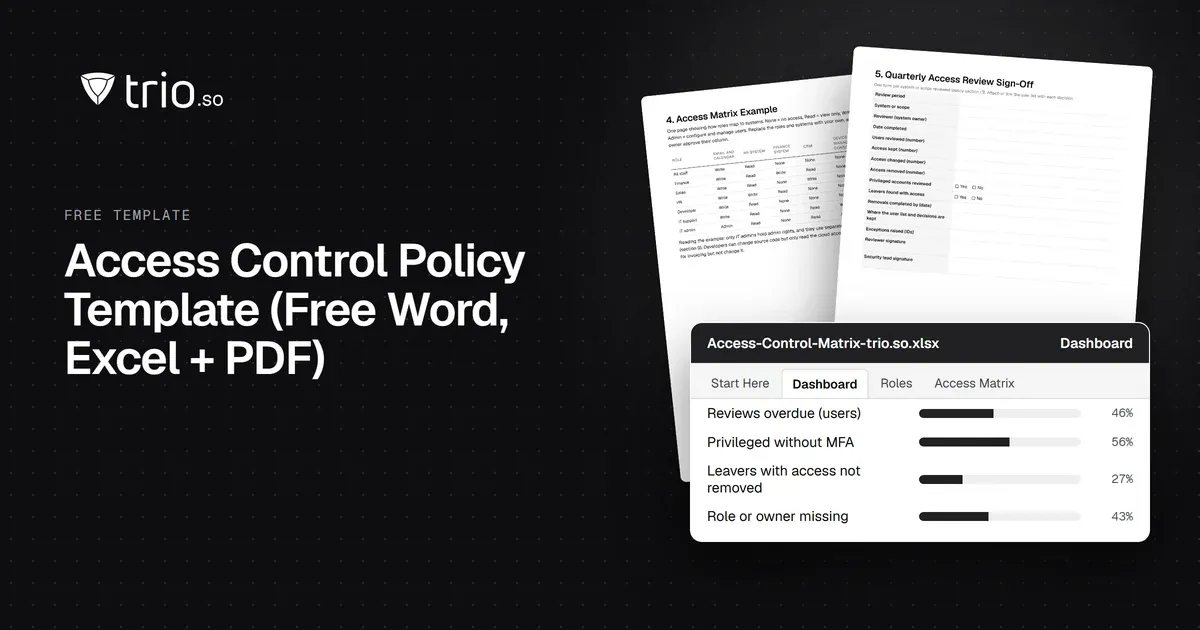
Free access control policy template with joiner, mover and leaver steps, an RBAC matrix, privileged access rules and ISO 27001 and NIST mapping.
Create an effective Service Level Agreement (SLA) template to ensure a clear and mutually beneficial service relationship between providers and clients.
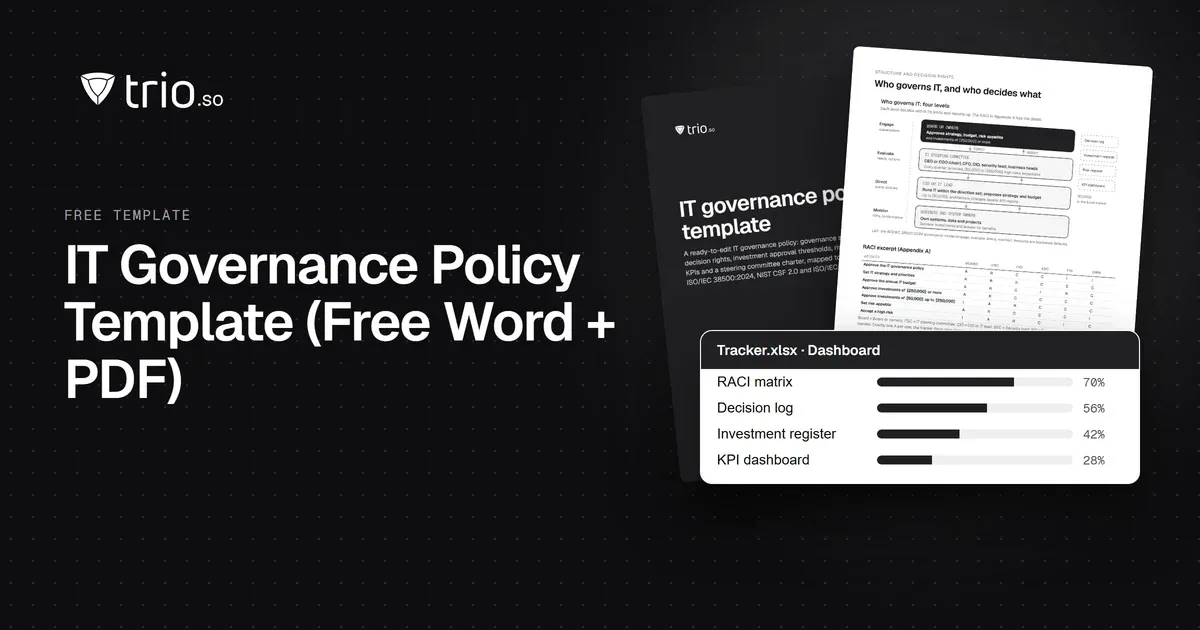
Free IT governance policy template in Word and PDF, with an Excel tracker: 17 sections, a RACI, decision rights, KPIs and a framework example.
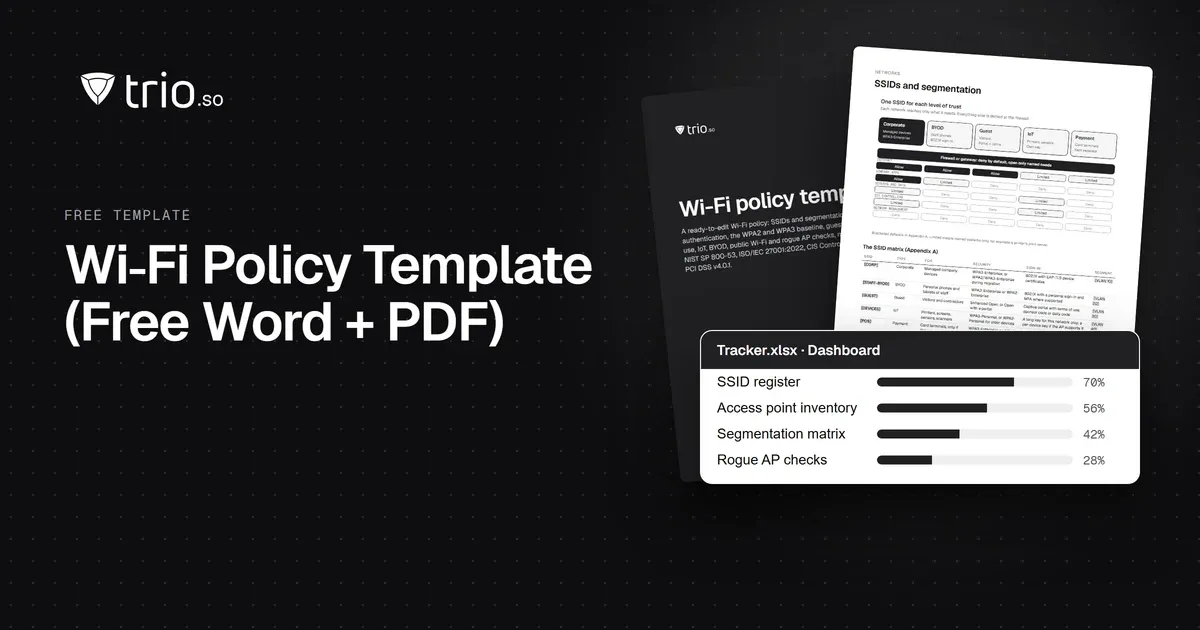
Free Wi-Fi policy template in Word and PDF, with an Excel tracker: 17 sections on SSIDs, WPA3, guest terms of use, BYOD and rogue AP checks.
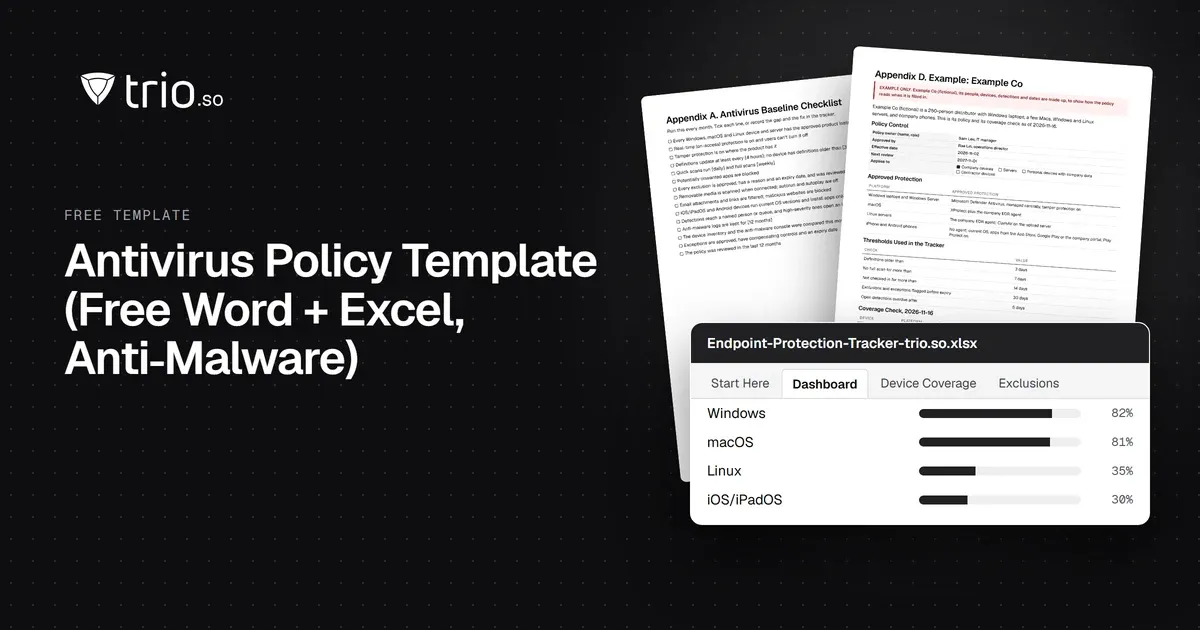
Free antivirus and anti-malware policy template in Word and PDF, with a baseline checklist, a filled-in example and an Excel endpoint coverage tracker.
A free compliance checklist template for IT teams: ten areas with owners, status and evidence, plus an Excel workbook, framework crosswalk and Word guide.
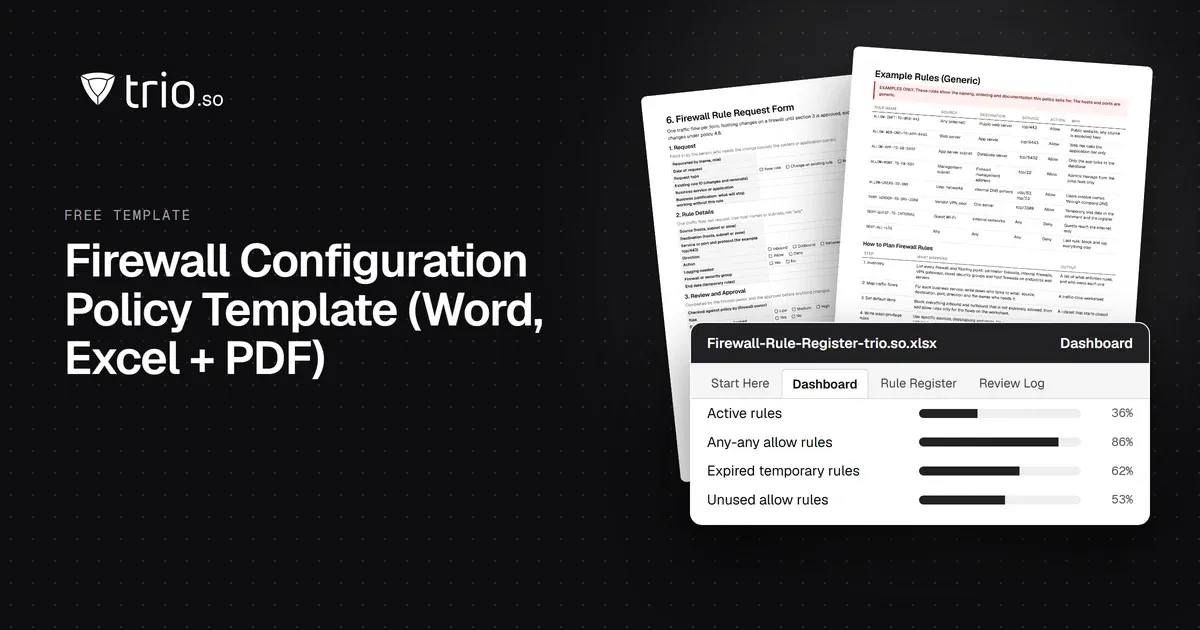
Free firewall configuration policy (Word, PDF) and an Excel rule register that flags any-any, unowned, expired and unused rules. Plus how to plan rules.
14-day free trial. No credit card required.
trio.so for MSPs: one console, separate clients