



MSP
MSP Onboarding Checklist (Free Word + Excel Template)
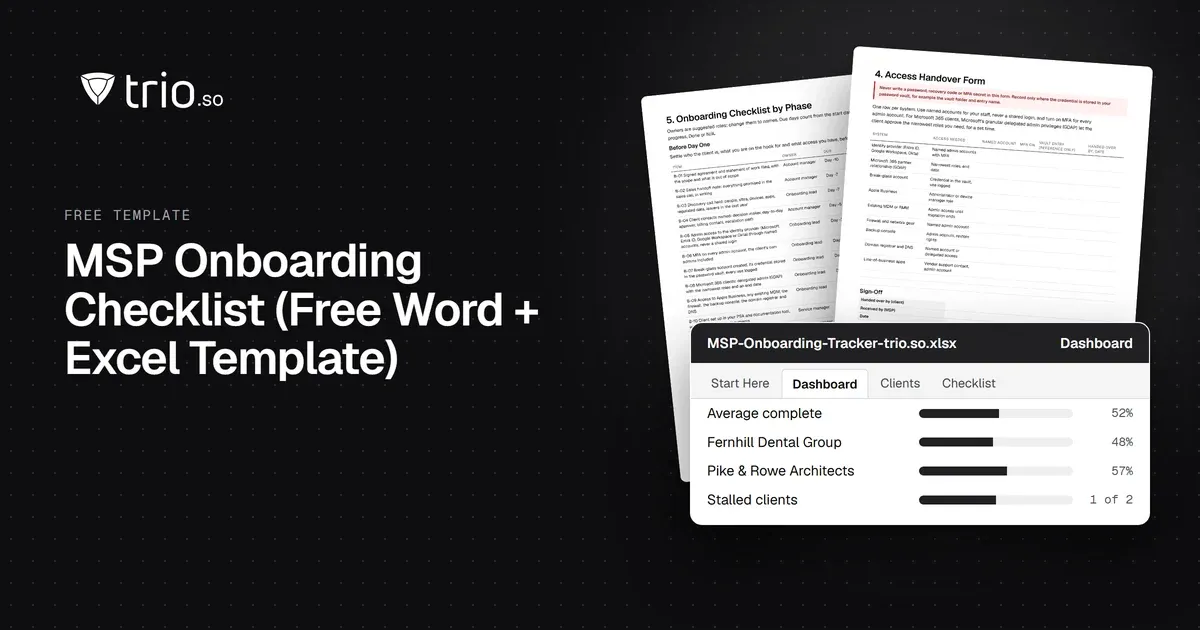
Free MSP onboarding checklist in Word, Excel and PDF: access handover, inventory, enrollment, baseline policies, a security check and offboarding.
How MSPs launch and price a compliance as a service offer: frameworks clients face, packaging, pricing models, evidence and what not to promise.

Content writer, trio.so
Compliance as a service (CaaS) is a recurring service where an MSP runs the controls, monitoring and evidence a client needs for a framework such as HIPAA or CMMC. The client stays responsible for compliance itself. You sell the work and the proof of the work, not a certificate.
This guide is for MSP owners and MSSP leads deciding whether to launch a CaaS offer. It covers which frameworks clients bring, how to package the service, how to price it with a worked 20 client example, and what you should never promise in a contract.
Small and mid size clients get pulled into frameworks by someone else: a healthcare partner asks for a business associate agreement, a defense prime asks about CMMC, an insurer sends a controls questionnaire, an enterprise customer sends a security review. The client has no one who can answer. They already pay you to run their devices, so you are the obvious person to ask.
That is the commercial case. Much of that work is already running in a managed client: patching, encryption, access control and backups are the technical controls every framework asks about. CaaS packages that work with a framework mapping, a gap list and a regular evidence report, and charges for it every month.
The offer works when it replaces a pile of one off requests with one steady service. It fails when it becomes unpaid questionnaire help bolted onto the existing contract.
Start with one framework, master it, then add the next. N-able's guide to launching CaaS gives the same advice: pick the framework that matches the industries you already serve (N-able, "How MSPs can successfully launch and deliver compliance as a service", read 12 Nov 2026). Here are five frameworks you are likely to meet:
| Framework | Who it hits | What the client asks the MSP for |
|---|---|---|
| HIPAA (US health privacy law) | Healthcare providers and their business associates in the US. An MSP that can reach patient data is often a business associate itself. | A signed business associate agreement, device encryption, access controls, risk assessment records |
| CMMC (Cybersecurity Maturity Model Certification) | Defense contractors that handle controlled unclassified information. Level 2 follows NIST SP 800-171. | Control mapping, a gap list, evidence for a self assessment or an assessor. Check the current phase dates on the DoD CIO CMMC page before you quote a client. |
| SOC 2 (a security report from an independent auditor) | SaaS and service companies whose customers ask for a report | Evidence that controls run over time: patching, access reviews, device inventory |
| Cyber insurance | Any client renewing a policy | Answers and proof for the underwriter's controls questionnaire |
| NIS2 (the EU network and information security directive) | Entities in the EU in covered sectors. IT service management for other businesses is itself a covered sector, so an MSP serving EU clients may be in scope as well as its clients, depending on its size. | Risk management measures, incident handling records, supply chain security |
Each of these deserves its own post. Check dates and scope in the primary source before you put them in a proposal. CMMC phase dates and NIS2 national rules are still changing.
Define the scope before you set a price. ScalePad's guidance is the same: scope, client profile, tooling and staffing drive the price, so write those down first (ScalePad, "Four pricing strategies MSPs should consider for compliance as a service", 26 Mar 2024). Four parts cover most offers:
Keep extras such as awareness training, incident response planning and penetration testing as separate priced options. Clients often want them after the first assessment, and bundling them hides the cost.
ScalePad lists four pricing models: fixed fee, hourly, monthly retainer and value based (ScalePad, 26 Mar 2024). A common setup for CaaS is a one time assessment fee plus a monthly retainer in tiers. The retainer is the recurring revenue. The assessment fee is paid once and covers setup.
We found no published market price range for CaaS, so we give none. Price from your own cost instead, with this floor price formula:
Minimum monthly revenue = monthly cost of the service divided by (1 minus your target margin).
At a 40 percent target margin the divisor is 0.6, so a cost of $10,500 a month needs $17,500 a month in revenue.
The numbers below are invented to show the arithmetic. Replace every input with your own.
| Tier | Clients | Price per client per month | Revenue per month |
|---|---|---|---|
| Essentials: one framework, quarterly evidence report | 10 | $400 | $4,000 |
| Standard: one framework, monthly evidence report, quarterly review | 7 | $800 | $5,600 |
| Advanced: two frameworks, monthly report, monthly review | 3 | $1,500 | $4,500 |
| Total | 20 | $14,100 |
| Monthly cost | Amount |
|---|---|
| One compliance analyst, fully loaded | $7,500 |
| Tooling and evidence collection | $1,200 |
| Outside specialist review | $1,000 |
| Insurance and overhead share | $800 |
| Total | $10,500 |
Revenue of $14,100 less cost of $10,500 leaves $3,600, a margin of 25.5 percent. For a 40 percent margin the floor formula says you need $17,500. The revenue shortfall is $3,400 a month, or $170 per client. You can close it by raising prices (the average has to go from $705 to $875 per client, which is $14,100 and $17,500 divided by 20), by cutting analyst hours with automation, or by moving clients from Essentials to Standard. Do the math before you publish a price list, not after the first quarter.
Add the one time assessment on top. At $2,500 per new client, ten onboarded clients bring $25,000 up front. That covers setup work and is not part of the monthly margin above.
Evidence is where CaaS margin disappears. An analyst who collects screenshots and exports by hand for 20 clients spends the month on collection and has no time for advice. Auditors and insurers ask for proof that a control ran over time, so a one off screenshot is weak.
The technical part of that evidence comes straight from the endpoint tool you already run: which devices exist, which are encrypted, which are patched, which policies apply. trio.so is a multi tenant console for MSPs: one console for all your client fleets. For the technical side of a framework, it covers the controls a device management tool can enforce, such as encryption, patching and policies, in frameworks like SOC 2, ISO 27001 and NIST. It helps you work toward those frameworks and exports compliance evidence per client, including a patch audit trail, which supports external audits. It does not certify anyone, and the administrative controls (policies, training, vendor reviews) sit outside any device tool. See MDM for MSPs for how the multi tenant console works. Plans start at $5 per device.
Certification and compliance belong to the client and the auditor. Your contract and your sales language should say so.
Apply the same rule to yourself. Assess your own MSP against the framework first, as the N-able guide suggests, and you will find the gaps before a client does.
For the groundwork this builds on, read what an MSP is, the MSP software stack, managed IT services and the MSP security stack.
trio.so brings device management, patching and security policies for Windows, macOS, Linux, iOS/iPadOS and Android into one console. Enroll a device and see it in the console within minutes.
trio.so brings device management, patching and security policies for Windows, macOS, Linux, iOS/iPadOS and Android into one console. Enroll a device and see it in the console within minutes.





Related
The related industry news, interviews, technologies, and resources.
Free MSP onboarding checklist in Word, Excel and PDF: access handover, inventory, enrollment, baseline policies, a security check and offboarding.
NIS2 covers managed service providers across the EU. See when it applies to your MSP, what Germany's law says, and what clients will ask you to show.
The MSP security stack in 2026: the layers to cover, the tool category in each, and what clients now expect you to show. Start with endpoints and identity.
Best RMM software for MSPs in 2026, compared on multi-tenancy, Mac and Linux coverage, patching, remote access and pricing.
MSP vs MSSP in plain terms: what each delivers, where patching and endpoint security overlap, and when an MSP should partner for MDR or build.
Co-managed IT explained: who does what, how to split roles between internal IT and an MSP, and how to give both access to one device console.
The MSP software stack by job in 2026: RMM, PSA, MDM, patching, backup, security. What each covers, where RMM stops, and how to evaluate.
What is an MSP? A managed service provider runs a business's IT for a monthly fee. Here is what MSPs do, how they charge and how to choose one.
14-day free trial. No credit card required.
trio.so for MSPs: one console, separate clients