



Templates
NIST 800-171 Compliance Checklist: 110 Requirements and SPRS
A NIST 800-171 compliance checklist with all 110 Rev. 2 requirements, their SPRS points, Rev. 3 changes, CMMC status and a self-assessment guide. Free Excel.
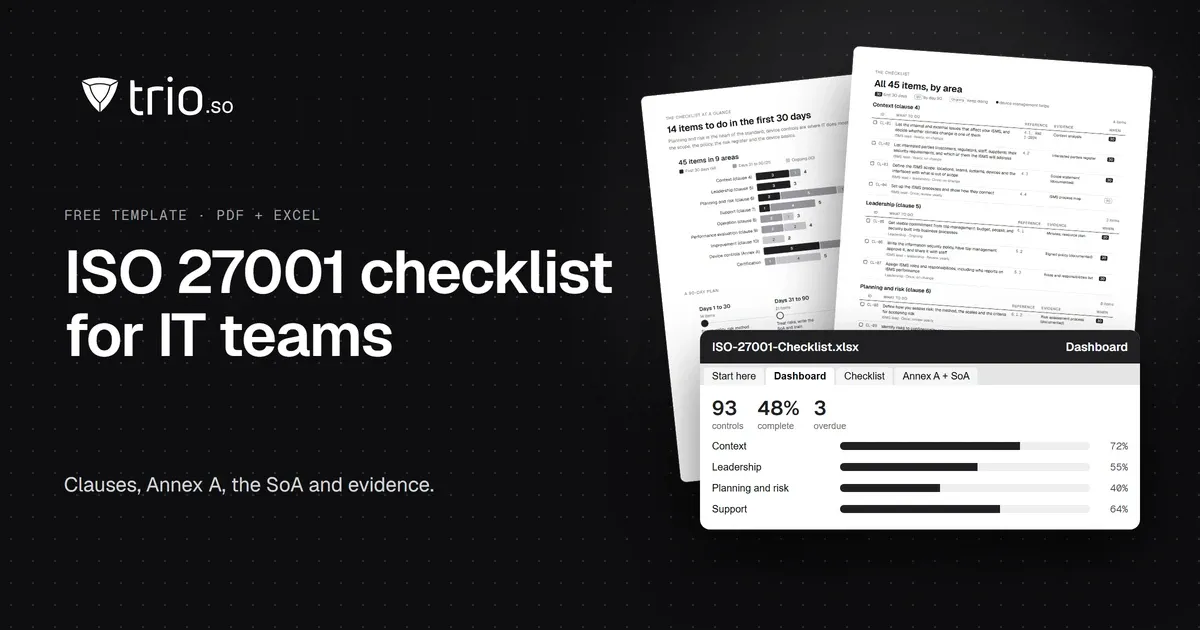
An ISO 27001 checklist for IT teams: clauses 4 to 10, all 93 Annex A controls with an SoA template, risk register and device controls. Free PDF and Excel.

Content writer, trio.so
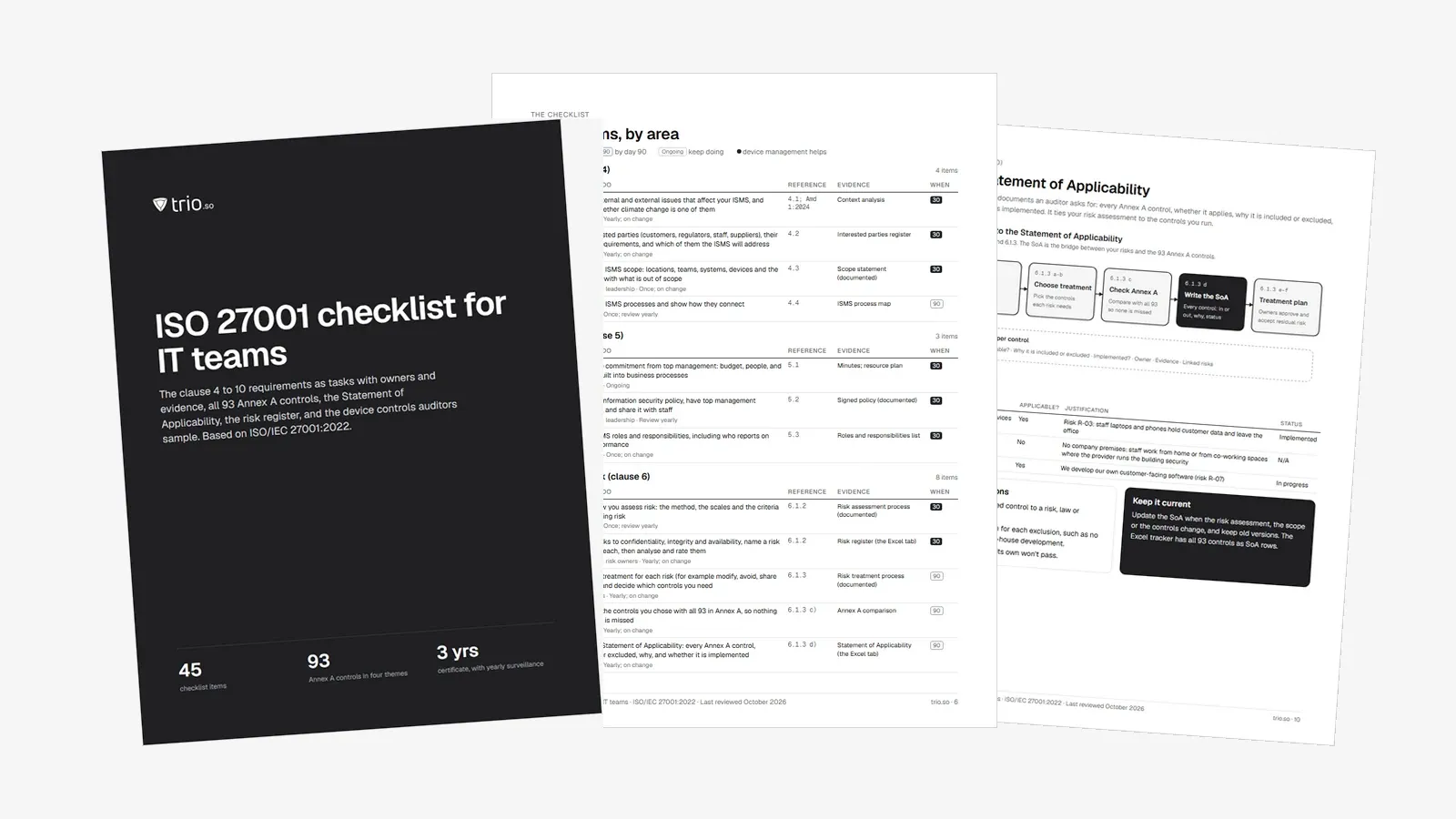
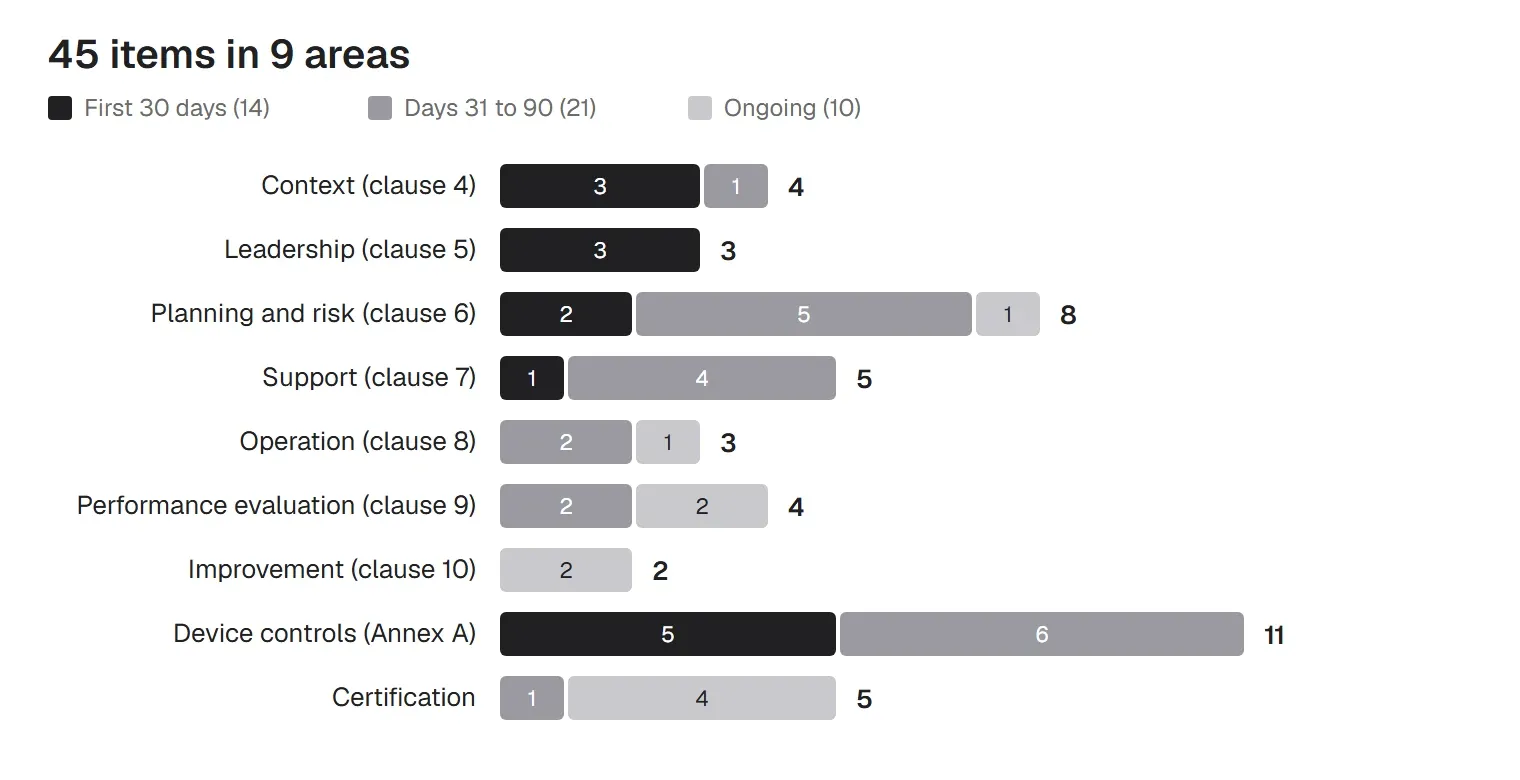
An ISO 27001 checklist turns the standard into tasks you can assign, finish and prove. This one follows ISO/IEC 27001:2022 and has 45 items: 29 for the requirements in clauses 4 to 10, 11 for the Annex A device controls that land on IT, and 5 for the steps to certification. It also lists all 93 Annex A controls, explains the Statement of Applicability, and shows the evidence an auditor will ask for.
It is written for the people who do the work: IT managers, sysadmins and MSPs at companies building an information security management system (ISMS) for the first time, or tidying one up before an audit. Use it as a gap analysis: go row by row, mark what you already have, and the gaps become your plan.
Download it as a printable PDF and an Excel tracker with a dashboard, a clause checklist, all 93 Annex A controls laid out as a Statement of Applicability, a risk register that scores each risk, a mandatory documents tracker, an internal audit plan and a corrective action log. Or work through it below.
In short
ISO/IEC 27001 sets the requirements for an information security management system: the policies, risk process, controls and reviews an organization uses to protect information. The current edition was published on 25 October 2022. It suits any size or sector, and certification is optional: some companies use it only as a framework.
Comparing frameworks? See ISO 27001 vs SOC 2 and NIST vs ISO. Smaller team? Our guide to ISO 27001 for small businesses covers what to plan for.
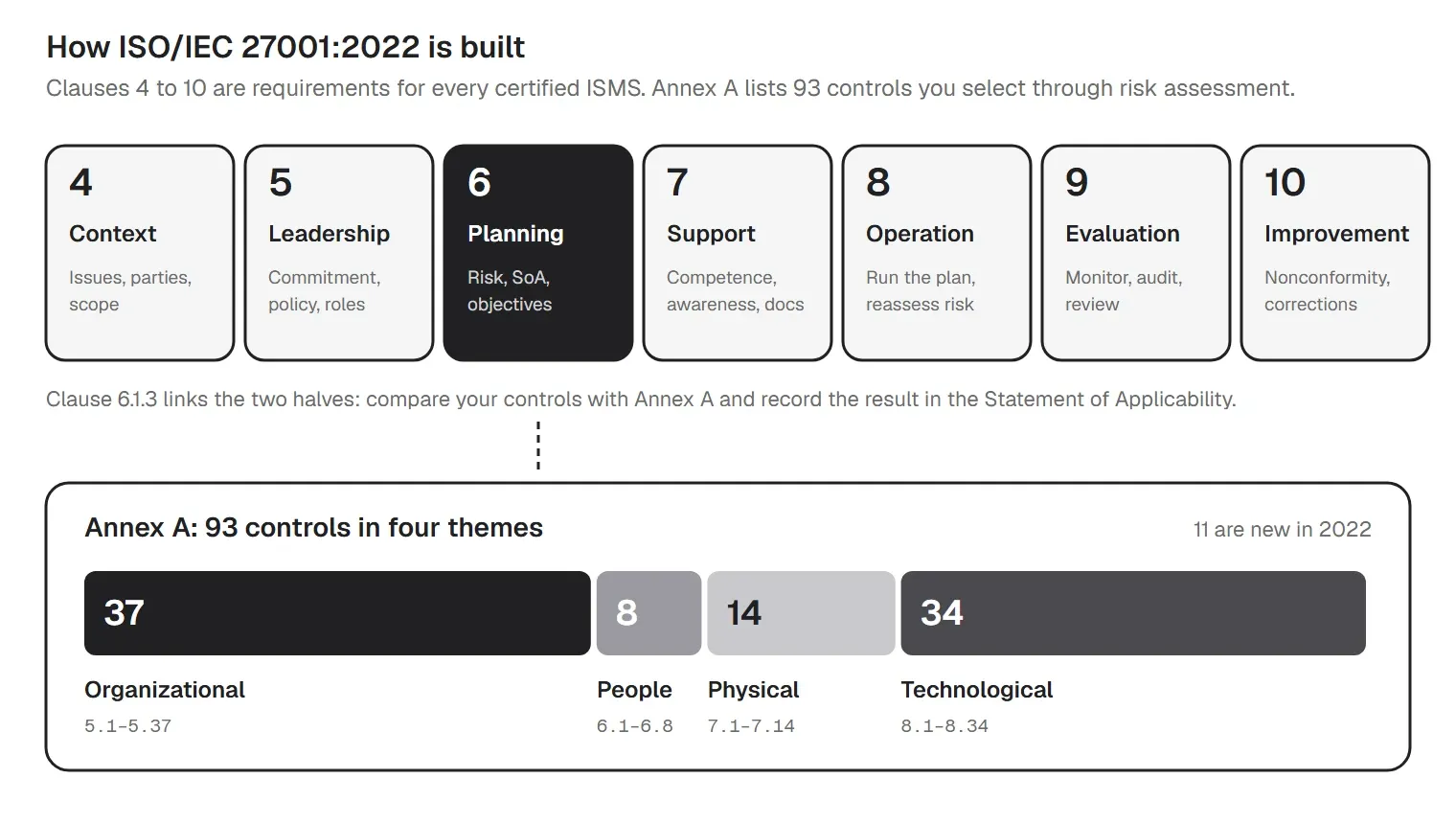
Clauses 0 to 3 set the context. Clauses 4 to 10 hold the requirements, and you can't leave any of them out if you claim conformity. Only Annex A controls can be excluded, with a reason in the Statement of Applicability.
| Clause | Title | What it asks for |
|---|---|---|
| 4 | Context of the organization | Issues, interested parties and their requirements, the ISMS scope, and the ISMS processes. |
| 5 | Leadership | Top management commitment, the information security policy, and assigned roles. |
| 6 | Planning | Risk assessment and treatment, the Statement of Applicability, objectives, and planned changes. |
| 7 | Support | Resources, competence, awareness, communication, and control of documents. |
| 8 | Operation | Run the processes, repeat risk assessments, and carry out the treatment plan. |
| 9 | Performance evaluation | Monitoring and measurement, internal audit, and management review. |
| 10 | Improvement | Continual improvement, and nonconformity and corrective action. |
Do the groundwork first. 14 items are marked "first 30 days": the scope, the policy, the risk method and register, document control, and the device basics.
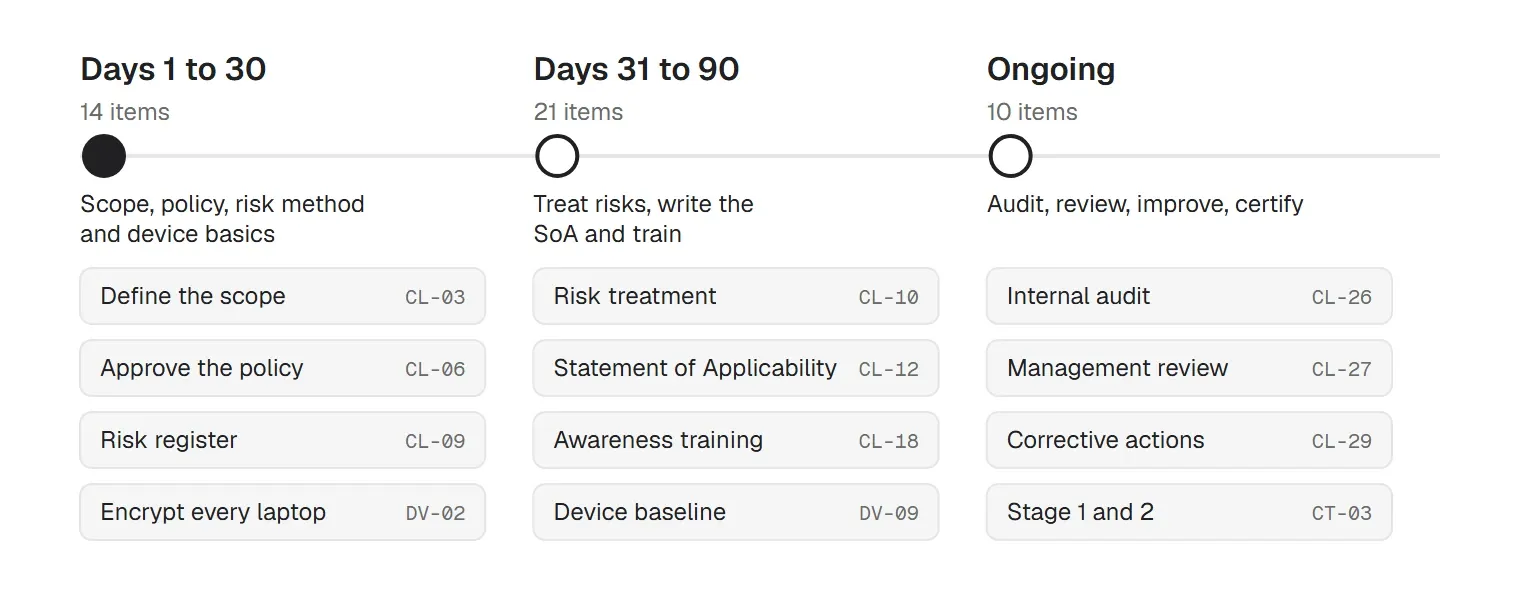
In the Excel tracker, filter the Phase column to see each list, and give every item an owner and a due date before you start. Certification usually follows once the ISMS has run for a while and produced records: the auditor needs evidence that it works, not only documents.
Each item lists the clause or control it comes from and the evidence to keep. "Documented" in the evidence column means the standard asks for documented information. The Excel tracker adds an owner, a frequency, a status and a due date for every row.
Start by writing down what the ISMS covers and why. A tight, clear scope saves work everywhere else, but it must include the people, systems and devices that handle the information you are protecting.
| ID | What to do | Reference | Evidence to keep |
|---|---|---|---|
| CL-01 | List the internal and external issues that affect your ISMS, and decide whether climate change is one of them (first 30 days) | 4.1; Amd 1:2024 | Context analysis |
| CL-02 | List interested parties (customers, regulators, staff, suppliers), their security requirements, and which of them the ISMS will address (first 30 days) | 4.2 | Interested parties register |
| CL-03 | Define the ISMS scope: locations, teams, systems, devices and the interfaces with what is out of scope (first 30 days) | 4.3 | Scope statement (documented) |
| CL-04 | Set up the ISMS processes and show how they connect | 4.4 | ISMS process map |
Top management owns the ISMS. Auditors look for real commitment: an approved policy, named roles, budget, and attendance at reviews. Our information security policy template gives you a starting draft.
| ID | What to do | Reference | Evidence to keep |
|---|---|---|---|
| CL-05 | Get visible commitment from top management: budget, people, and security built into business processes (first 30 days) | 5.1 | Minutes; resource plan |
| CL-06 | Write the information security policy, have top management approve it, and share it with staff (first 30 days) | 5.2 | Signed policy (documented) |
| CL-07 | Assign ISMS roles and responsibilities, including who reports on ISMS performance (first 30 days) | 5.3 | Roles and responsibilities list |
This is the core of ISO 27001. You assess risks, choose how to treat them, check your controls against Annex A, and record the result in the Statement of Applicability. Our technology risk assessment template helps with the first step.
| ID | What to do | Reference | Evidence to keep |
|---|---|---|---|
| CL-08 | Define how you assess risk: the method, the scales and the criteria for accepting risk (first 30 days) | 6.1.2 | Risk assessment process (documented) |
| CL-09 | Identify risks to confidentiality, integrity and availability, name a risk owner for each, then analyse and rate them (first 30 days) | 6.1.2 | Risk register (the Excel tab) |
| CL-10 | Choose a treatment for each risk (for example modify, avoid, share or retain) and decide which controls you need | 6.1.3 | Risk treatment process (documented) |
| CL-11 | Compare the controls you chose with all 93 in Annex A, so nothing necessary is missed | 6.1.3 c) | Annex A comparison |
| CL-12 | Write the Statement of Applicability: every Annex A control, included or excluded, why, and whether it is implemented | 6.1.3 d) | Statement of Applicability (the Excel tab) |
| CL-13 | Write the risk treatment plan, and get risk owners to approve it and accept the residual risk | 6.1.3 e)–f) | Risk treatment plan; sign-offs |
| CL-14 | Set measurable security objectives, with who, what, by when and how you will check them | 6.2 | Objectives (documented) |
| CL-15 | Plan changes to the ISMS before you make them | 6.3 | Change records |
The ISMS needs people who know what to do and documents that are controlled. Version, approve and review every document the ISMS depends on.
| ID | What to do | Reference | Evidence to keep |
|---|---|---|---|
| CL-16 | Give the ISMS the people, time and budget it needs | 7.1 | Budget; resource plan |
| CL-17 | Define the competence each ISMS role needs, close the gaps, and keep proof | 7.2 | Competence records (documented) |
| CL-18 | Make sure staff know the policy, their part in it, and what happens if they ignore it | 7.3 | Awareness training records |
| CL-19 | Decide what you communicate about security, to whom, when and how | 7.4 | Communication plan |
| CL-20 | Control your ISMS documents: owner, version, approval, access, retention (first 30 days) | 7.5 | Document register |
Run the plan. Repeat the risk assessment at planned intervals and whenever something significant changes, such as a new office, system or supplier, and keep the results.
| ID | What to do | Reference | Evidence to keep |
|---|---|---|---|
| CL-21 | Plan and control the processes that deliver security, including services from suppliers and cloud providers | 8.1 | Operating records |
| CL-22 | Repeat the risk assessment at planned intervals and after significant change, and keep the results | 8.2 | Risk assessment results (documented) |
| CL-23 | Carry out the risk treatment plan and keep the results | 8.3 | Risk treatment results (documented) |
Measure whether the ISMS works, audit it yourself, and have top management review it. Stage 1 of the certification audit checks that these have happened.
| ID | What to do | Reference | Evidence to keep |
|---|---|---|---|
| CL-24 | Decide what to monitor and measure, how and when, and who analyses the results | 9.1 | Monitoring results (documented) |
| CL-25 | Plan an internal audit programme that covers the whole ISMS, with impartial auditors | 9.2 | Audit programme (documented) |
| CL-26 | Run the internal audits, report the results to management, and keep the evidence | 9.2 | Audit reports (documented) |
| CL-27 | Hold management reviews with the required inputs, and record the decisions | 9.3 | Management review minutes (documented) |
When something goes wrong, or an audit finds a gap, fix the cause, not only the symptom, and record it.
| ID | What to do | Reference | Evidence to keep |
|---|---|---|---|
| CL-28 | Keep a list of improvements and act on it | 10.1 | Improvement log |
| CL-29 | For each nonconformity: contain it, find the cause, fix it, check the fix worked, and record it all | 10.2 | Nonconformity and corrective action log (documented) |
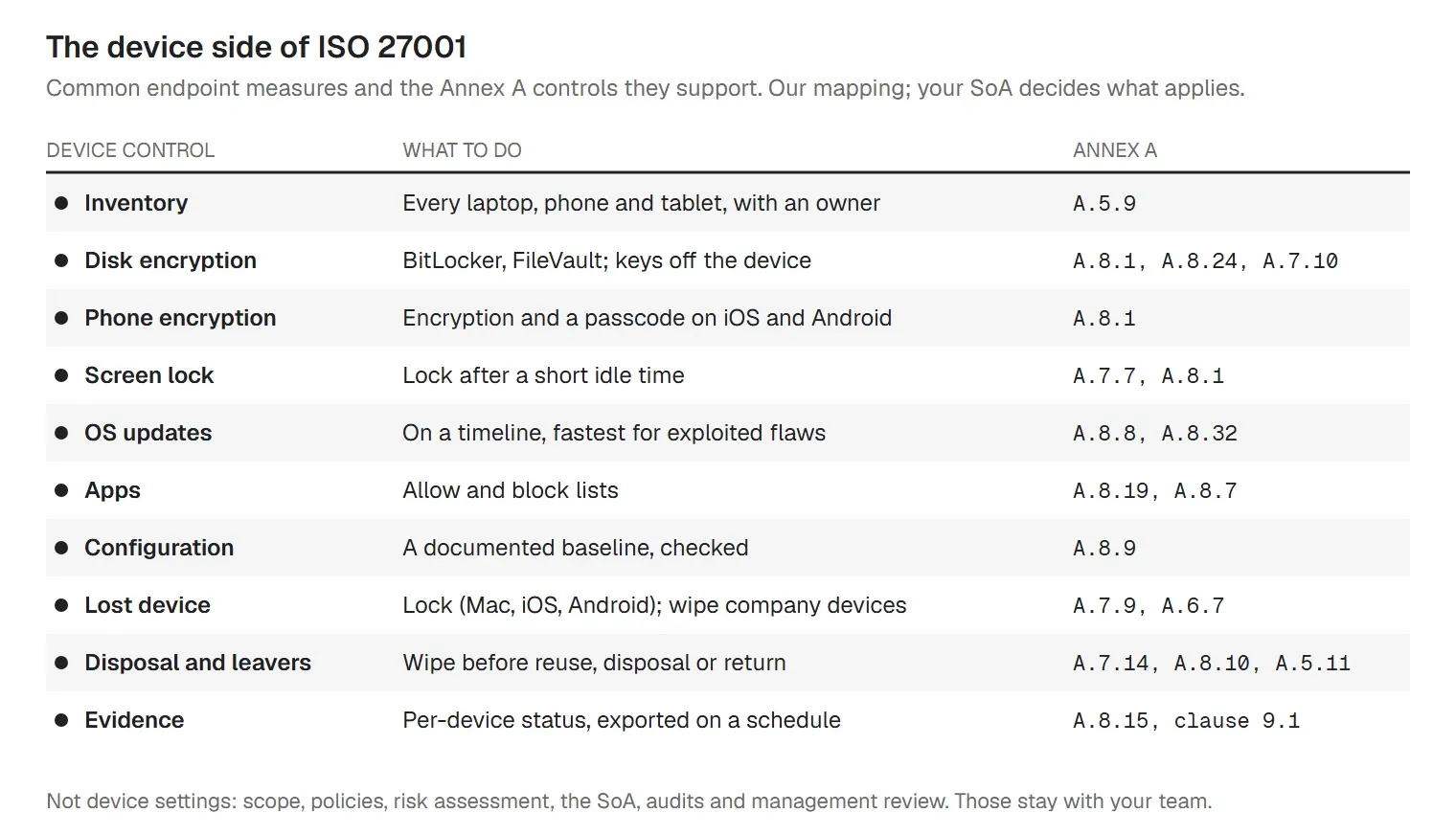
Laptops and phones carry information out of the office, so several Annex A controls land on IT. These are the device items most ISMS scopes need; your SoA decides which apply. See also our BYOD policy template and patch management policy template.
| ID | What to do | Reference | Evidence to keep |
|---|---|---|---|
| DV-01 | Keep an inventory of laptops, phones and tablets with an owner for each, and reconcile it (first 30 days) | A.5.9 | Device inventory export |
| DV-02 | Encrypt every laptop (BitLocker, FileVault) and keep recovery keys off the device (first 30 days) | A.8.1, A.8.24 | Encryption status per device |
| DV-03 | Encrypt phones and tablets and require a passcode (first 30 days) | A.8.1 | Mobile encryption and passcode report |
| DV-04 | Lock screens after a short idle time (first 30 days) | A.7.7, A.8.1 | Screen-lock settings report |
| DV-05 | Install OS updates on a set timeline, fastest for actively exploited flaws (first 30 days) | A.8.8, A.8.32 | Patch compliance report |
| DV-06 | Control which apps can be installed on company devices | A.8.19, A.8.7 | App allow and block lists |
| DV-07 | Have a lost-device process: report at once, lock, and wipe if needed | A.7.9, A.6.7 | Incident record with actions and times |
| DV-08 | Wipe devices before reuse or disposal, and keep a record | A.7.14, A.8.10 | Wipe and disposal records |
| DV-09 | Document a secure configuration baseline for endpoints and check devices against it | A.8.9 | Baseline; compliance report |
| DV-10 | Recover or wipe company devices when people leave | A.5.11, A.5.18 | Leaver records |
| DV-11 | Write a topic-specific policy for endpoint devices, including personal devices (BYOD) | A.8.1, A.6.7 | Endpoint and BYOD policy |
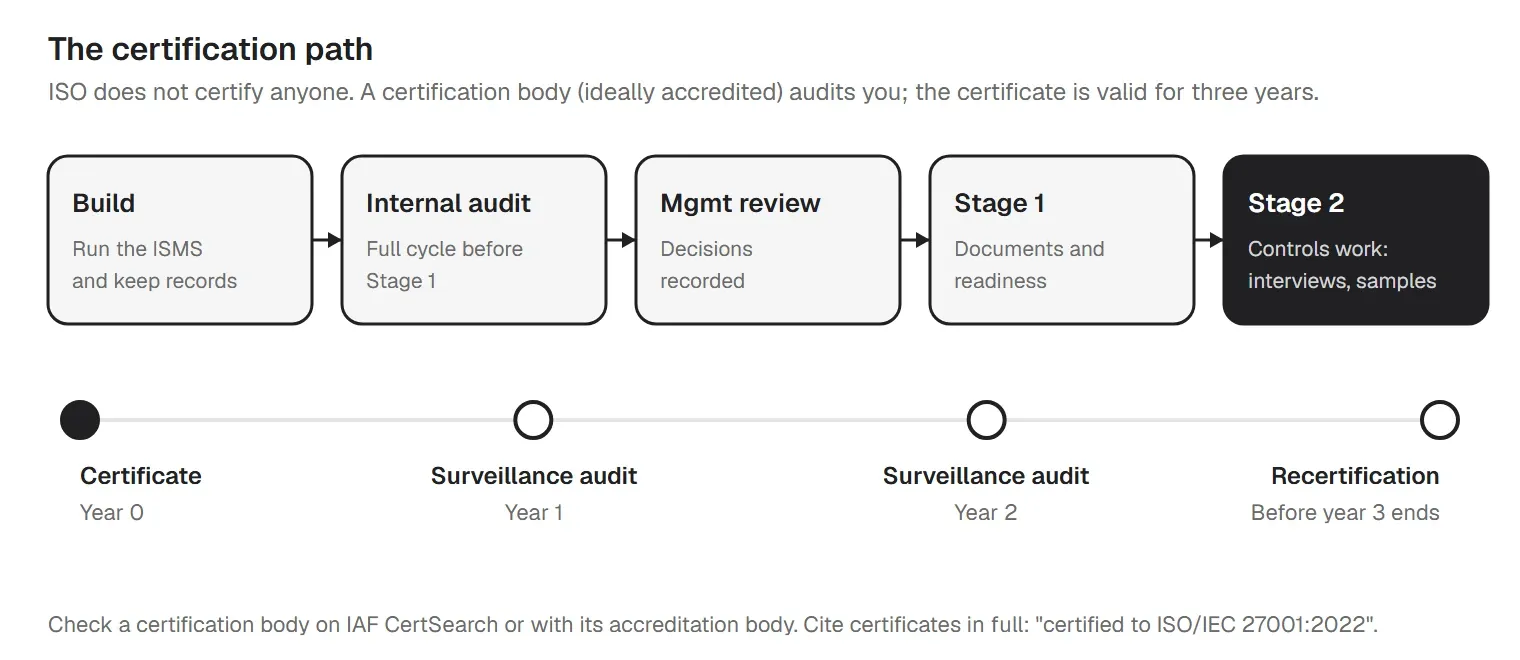
Certification is optional, but many companies doing this work want the certificate for customers. The audit happens in two stages, then repeats every year.
| ID | What to do | Reference | Evidence to keep |
|---|---|---|---|
| CT-01 | Decide whether to certify. If yes, choose an accredited certification body and check its accreditation | ISO/IEC 27006-1 | Certification body contract |
| CT-02 | Run at least one full internal audit and one management review before the Stage 1 audit | 9.2, 9.3 | Audit report; review minutes |
| CT-03 | Stage 1: the auditor reviews your documents and readiness. Fix the findings before Stage 2 | Certification | Stage 1 report; actions |
| CT-04 | Stage 2: the auditor tests that the ISMS and controls work, through interviews and samples of evidence | Certification | Stage 2 report; certificate |
| CT-05 | Keep it running: surveillance audits every year and a recertification audit before the third year ends | Certification | Surveillance reports |
The standard asks for "documented information", not named documents in a set format. These are the items clauses 4 to 10 require for every certified ISMS:
| Documented information | Clause |
|---|---|
| ISMS scope | 4.3 |
| Information security policy | 5.2 |
| Risk assessment process | 6.1.2 |
| Risk treatment process | 6.1.3 |
| Statement of Applicability | 6.1.3 d) |
| Risk treatment plan | 6.1.3 e), 8.3 |
| Information security objectives | 6.2 |
| Evidence of competence | 7.2 |
| Other documents you decide the ISMS needs | 7.5.1 b) |
| Operational records, enough to show processes ran as planned | 8.1 |
| Results of risk assessments | 8.2 |
| Results of risk treatment | 8.3 |
| Monitoring and measurement results | 9.1 |
| Internal audit programme and results | 9.2 |
| Management review results | 9.3 |
| Nonconformities, actions taken and results of corrective action | 10.2 |
Annex A adds more, but only for the controls you include in your SoA. The common ones are topic-specific policies (A.5.1), an asset inventory (A.5.9), acceptable use rules (A.5.10), access control rules (A.5.15), an incident management plan (A.5.24), endpoint device rules (A.8.1), secure configurations (A.8.9), cryptography rules (A.8.24) and a change management procedure (A.8.32). Our templates cover several of these: access control, acceptable use, IT asset management, data encryption, configuration management and remote work, plus a cybersecurity incident response plan.
The Statement of Applicability is one of the first documents an auditor asks for. Clause 6.1.3 d) asks for it: every Annex A control, whether it applies to you, why it is included or excluded, and whether it is implemented. It ties your risk assessment to the controls you run.
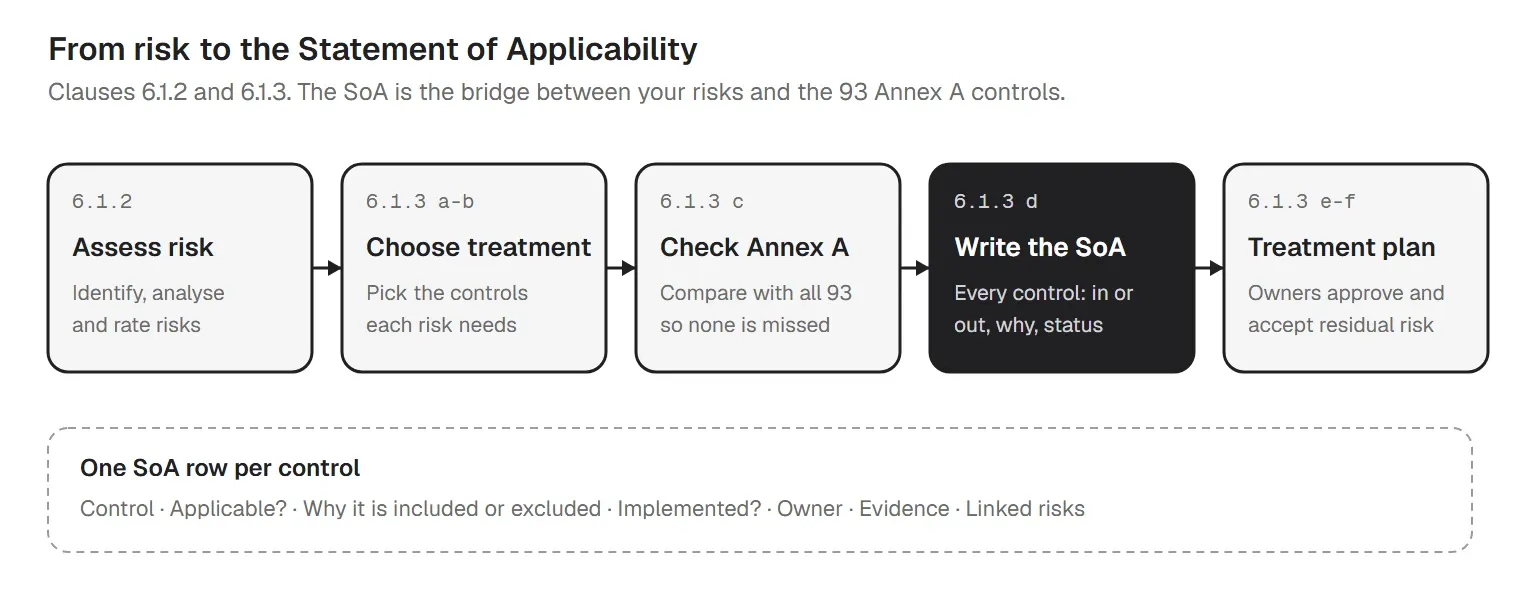
Here is what three rows can look like:
| Control | Applicable? | Justification | Status |
|---|---|---|---|
| A.8.1 User endpoint devices | Yes | Risk R-03: staff laptops and phones hold customer data and leave the office | Implemented |
| A.7.4 Physical security monitoring | No | No company premises: staff work from home or from co-working spaces where the provider runs the building security | N/A |
| A.8.28 Secure coding | Yes | We develop our own customer-facing software (risk R-07) | In progress |
Clause 6.1.2 asks you to define a risk process and apply it consistently: criteria for accepting risk, a way to identify risks to confidentiality, integrity and availability, an owner for each risk, and a rating. Clause 6.1.3 asks you to treat the risks, and clauses 8.2 and 8.3 ask you to repeat the assessment and keep the results.
| ID | Asset | Threat and weakness | Score (L×I) | Treatment and controls |
|---|---|---|---|---|
| R-03 | Staff laptops | Loss or theft: unencrypted disk on some devices | 4×4 = 16 | Modify: A.8.1, A.8.24, A.7.9 |
| R-05 | Customer database | Unauthorized access: shared admin account | 3×5 = 15 | Modify: A.5.15, A.5.18, A.8.2, A.8.5 |
| R-07 | Customer app | Exploited code flaw: no secure coding standard | 3×4 = 12 | Modify: A.8.25, A.8.28, A.8.29 |
The Excel risk register scores likelihood times impact on a 1 to 5 scale, flags scores of 15 and above, and has columns for the treatment, linked controls, residual risk and the owner's acceptance. Choose your own scale and acceptance level; the standard doesn't set one.
Annex A lists 93 controls in four themes. The 2013 version had 114 controls in 14 clauses; the 2022 version merged and renamed many of them and added 11 new ones: A.5.7, A.5.23, A.5.30, A.7.4, A.8.9, A.8.10, A.8.11, A.8.12, A.8.16, A.8.23, A.8.28. ISO/IEC 27002 explains each control and tags it with attributes such as preventive or detective, and confidentiality, integrity or availability.
You don't have to implement all 93. You choose the controls your risks need, then check the full list so nothing necessary is missed. The "Device-related" column marks the controls where laptops and phones usually play a part. The Excel tracker has every control as an SoA row.
| Control | Title | Device-related |
|---|---|---|
| A.5.1 | Policies for information security | |
| A.5.2 | Information security roles and responsibilities | |
| A.5.3 | Segregation of duties | |
| A.5.4 | Management responsibilities | |
| A.5.5 | Contact with authorities | |
| A.5.6 | Contact with special interest groups | |
| A.5.7 | Threat intelligence (new in 2022) | |
| A.5.8 | Information security in project management | |
| A.5.9 | Inventory of information and other associated assets | Yes |
| A.5.10 | Acceptable use of information and other associated assets | Yes |
| A.5.11 | Return of assets | Yes |
| A.5.12 | Classification of information | |
| A.5.13 | Labelling of information | |
| A.5.14 | Information transfer | |
| A.5.15 | Access control | Yes |
| A.5.16 | Identity management | |
| A.5.17 | Authentication information | |
| A.5.18 | Access rights | Yes |
| A.5.19 | Information security in supplier relationships | |
| A.5.20 | Addressing information security within supplier agreements | |
| A.5.21 | Managing information security in the ICT supply chain | |
| A.5.22 | Monitoring, review and change management of supplier services | |
| A.5.23 | Information security for use of cloud services (new in 2022) | |
| A.5.24 | Information security incident management planning and preparation | |
| A.5.25 | Assessment and decision on information security events | |
| A.5.26 | Response to information security incidents | |
| A.5.27 | Learning from information security incidents | |
| A.5.28 | Collection of evidence | |
| A.5.29 | Information security during disruption | |
| A.5.30 | ICT readiness for business continuity (new in 2022) | |
| A.5.31 | Legal, statutory, regulatory and contractual requirements | |
| A.5.32 | Intellectual property rights | |
| A.5.33 | Protection of records | |
| A.5.34 | Privacy and protection of PII | |
| A.5.35 | Independent review of information security | |
| A.5.36 | Compliance with policies, rules and standards for information security | |
| A.5.37 | Documented operating procedures |
| Control | Title | Device-related |
|---|---|---|
| A.6.1 | Screening | |
| A.6.2 | Terms and conditions of employment | |
| A.6.3 | Information security awareness, education and training | |
| A.6.4 | Disciplinary process | |
| A.6.5 | Responsibilities after termination or change of employment | |
| A.6.6 | Confidentiality or non-disclosure agreements | |
| A.6.7 | Remote working | Yes |
| A.6.8 | Information security event reporting |
| Control | Title | Device-related |
|---|---|---|
| A.7.1 | Physical security perimeters | |
| A.7.2 | Physical entry | |
| A.7.3 | Securing offices, rooms and facilities | |
| A.7.4 | Physical security monitoring (new in 2022) | |
| A.7.5 | Protecting against physical and environmental threats | |
| A.7.6 | Working in secure areas | |
| A.7.7 | Clear desk and clear screen | Yes |
| A.7.8 | Equipment siting and protection | |
| A.7.9 | Security of assets off-premises | Yes |
| A.7.10 | Storage media | Yes |
| A.7.11 | Supporting utilities | |
| A.7.12 | Cabling security | |
| A.7.13 | Equipment maintenance | |
| A.7.14 | Secure disposal or re-use of equipment | Yes |
| Control | Title | Device-related |
|---|---|---|
| A.8.1 | User endpoint devices | Yes |
| A.8.2 | Privileged access rights | |
| A.8.3 | Information access restriction | |
| A.8.4 | Access to source code | |
| A.8.5 | Secure authentication | Yes |
| A.8.6 | Capacity management | |
| A.8.7 | Protection against malware | Yes |
| A.8.8 | Management of technical vulnerabilities | Yes |
| A.8.9 | Configuration management (new in 2022) | Yes |
| A.8.10 | Information deletion (new in 2022) | Yes |
| A.8.11 | Data masking (new in 2022) | |
| A.8.12 | Data leakage prevention (new in 2022) | Yes |
| A.8.13 | Information backup | |
| A.8.14 | Redundancy of information processing facilities | |
| A.8.15 | Logging | Yes |
| A.8.16 | Monitoring activities (new in 2022) | Yes |
| A.8.17 | Clock synchronization | |
| A.8.18 | Use of privileged utility programs | |
| A.8.19 | Installation of software on operational systems | Yes |
| A.8.20 | Networks security | |
| A.8.21 | Security of network services | |
| A.8.22 | Segregation of networks | |
| A.8.23 | Web filtering (new in 2022) | |
| A.8.24 | Use of cryptography | Yes |
| A.8.25 | Secure development life cycle | |
| A.8.26 | Application security requirements | |
| A.8.27 | Secure system architecture and engineering principles | |
| A.8.28 | Secure coding (new in 2022) | |
| A.8.29 | Security testing in development and acceptance | |
| A.8.30 | Outsourced development | |
| A.8.31 | Separation of development, test and production environments | |
| A.8.32 | Change management | Yes |
| A.8.33 | Test information | |
| A.8.34 | Protection of information systems during audit testing |
Time and cost vary with your scope, headcount and certification body; the number of audit days depends on headcount in scope. Ask two or three accredited bodies for quotes. For an internal ISO 27001 audit checklist, use clauses 4 to 10 above as the audit criteria and sample the SoA controls.
ISO 27001 names no product. But several Annex A controls depend on the laptops and phones your people carry, and auditors sample them: show me this laptop's encryption, show me how a lost phone was handled, show me that this leaver's device was wiped.
More ISO 27001 guides for IT teams
ISO 27001 is a management system: the scope, policies, risk assessment, SoA, audits and reviews are your organization's work, and certification depends on all of it. trio.so covers the device settings behind most of the device items in this checklist from one console, across Windows, Mac, iOS and Android:
trio.so does not write your SoA, risk register or policies, and it does not certify you. It gives you the device settings and the device evidence for them.
Comparing tools? Our guide to ISO 27001 compliance software covers what automation can and can't do. Learn more about compliance automation.
14-day free trial. No credit card required.
Handling personal data too? See the ISO 27701 checklist for privacy management, and our GDPR compliance checklist.
Sources. Last reviewed October 2026. Requirements are paraphrased, not quoted; check wording against your licensed copy of the standard. This article is guidance, not legal or certification advice. The mapping of device controls to Annex A is ours.
Every organization today needs a solution to automate time-consuming tasks and strengthen security. Without the right tools, manual processes drain resources and leave gaps in protection. trio.so is designed to solve this problem, automating key tasks, boosting security, and ensuring compliance with ease.
Every organization today needs a solution to automate time-consuming tasks and strengthen security. Without the right tools, manual processes drain resources and leave gaps in protection. trio.so is designed to solve this problem, automating key tasks, boosting security, and ensuring compliance with ease.





Have questions? We've got answers. This section covers some of the most commonly asked questions related to this topic.
Related
The related industry news, interviews, technologies, and resources.
A NIST 800-171 compliance checklist with all 110 Rev. 2 requirements, their SPRS points, Rev. 3 changes, CMMC status and a self-assessment guide. Free Excel.
A SOC 2 compliance checklist for IT teams: 69 controls mapped to the Trust Services Criteria, with the evidence auditors sample. Free PDF and Excel.
Ten Microsoft Entra conditional access policy templates with what each does, the order to enable them in report-only mode, licensing, and a free download.
SAMA compliance checklist for the SAMA CSF: 4 domains and 32 subdomains, maturity levels 0 to 5, evidence and owners, with a free PDF and Excel tracker.
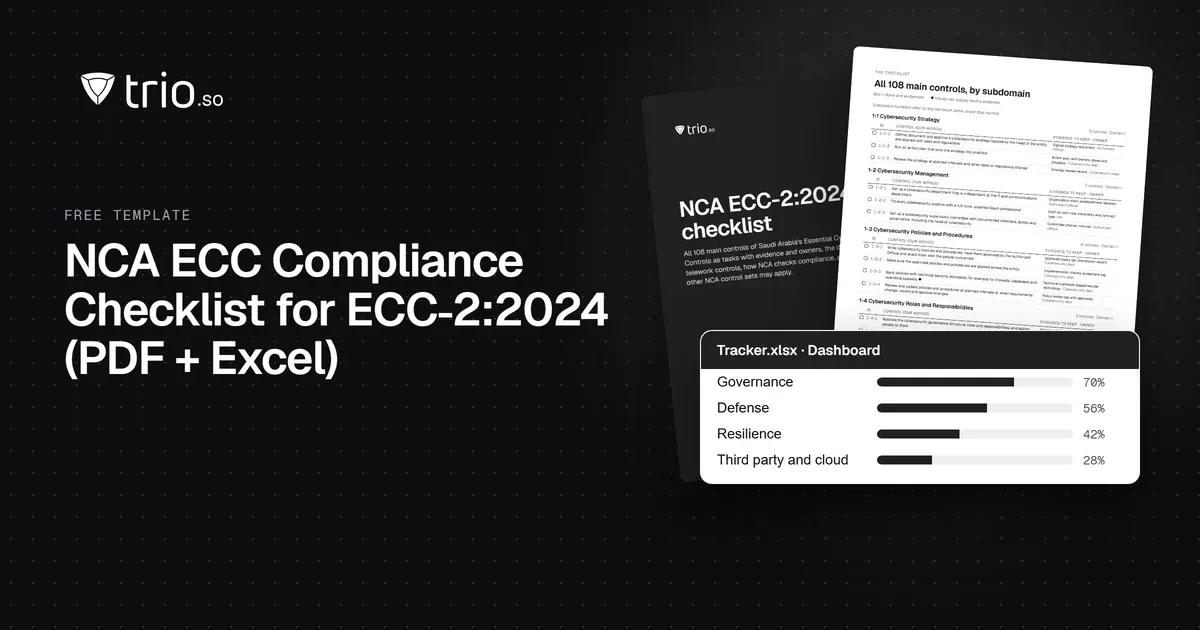
NCA ECC compliance checklist for ECC-2:2024: all 108 controls by domain, the evidence to keep and the device controls, with a free PDF and Excel tracker.
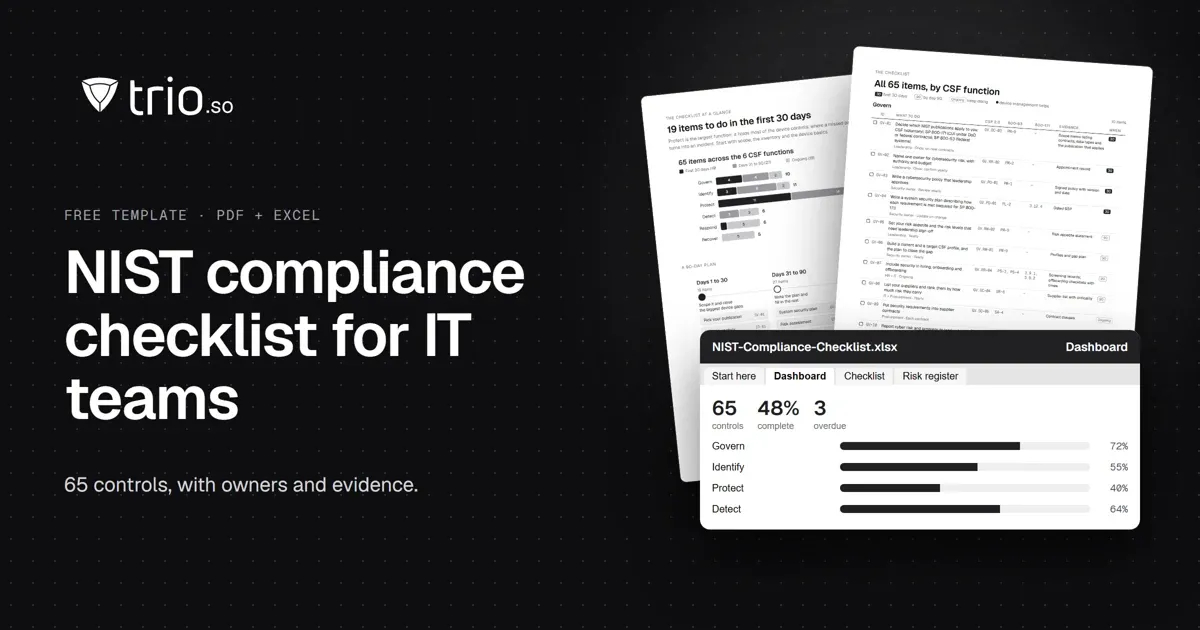
A NIST compliance checklist for IT teams: 65 controls by CSF 2.0 function, mapped to SP 800-53 and 800-171, with an SPRS calculator. Free PDF and Excel.
Feeling overwhelmed by CCPA? Use this comprehensive CCPA Compliance Checklist to secure customer data on mobile devices. Discover how MDM simplifies compliance.
Need an MDM audit checklist? Our guide covers 7 key areas & compliance strategies to ensure your mobile device management is secure and efficient.
14 day free trial. No credit card required.
trio.so for MSPs: one console, separate clients