




Explained
SP-Initiated vs. IdP-Initiated SSO: How Each SAML Flow Works
How SP-initiated and IdP-initiated SAML SSO work step by step, the replay and CSRF risks, when each fits, common SAML errors and how OIDC compares.
Vulnerability prioritization in three signals: CVSS says how bad, EPSS says how likely, CISA KEV says it is happening now. Learn what to patch first.

Content writer, trio.so
Patch the vulnerabilities on the CISA Known Exploited Vulnerabilities (KEV) list first, because they are already being exploited. Then sort what is left by EPSS, the Exploit Prediction Scoring System score for likelihood of exploitation in the next 30 days. Then weigh the CVSS (Common Vulnerability Scoring System) severity of what remains, and finish by asking how much the affected device matters to your business. That order gives you a list you can defend to a manager or an auditor.
Vulnerability prioritization means deciding which flaws to fix first. This guide explains what each of the three signals measures, where each one misleads you, and how to combine them on a fleet of laptops, desktops and phones.
CVSS describes how severe a flaw is in the abstract, not how likely anyone is to use it. A base score of 9.8 and a base score of 7.5 can both sit on your list, and the 7.5 may be the one attackers are using this week.
The score also does not know your environment. A critical flaw in software you have not installed is not a risk. A medium flaw in a browser every employee runs is. FIRST (the Forum of Incident Response and Security Teams), which maintains CVSS, says CVSS is more than the Base score: Base is the fixed severity score, Threat adds whether exploit code exists, and Environmental adds your own setup. Version 4.0 names those three parts explicitly.
The result is a long list where almost everything looks urgent. The three signals below shrink it.
| Signal | Question it answers | Scale | Maintained by | Blind spot |
|---|---|---|---|---|
| CVSS | How bad is it if exploited? | 0.0 to 10.0 (Low 0.1 to 3.9, Medium 4.0 to 6.9, High 7.0 to 8.9, Critical 9.0 to 10.0) | FIRST | Says nothing about likelihood or your environment |
| EPSS | How likely is exploitation in the next 30 days? | Probability from 0 to 1, with a percentile | FIRST | A prediction, not a fact |
| CISA KEV | Is it being exploited in the wild? | On the list or not | CISA | Only covers flaws CISA has listed. A flaw missing from KEV is not safe |
Sources: FIRST, CVSS v4.0 and EPSS pages; CISA, Known Exploited Vulnerabilities Catalog; all read 8 Nov 2026. CVSS v4.0 is the current version, but many databases still publish v3.1 scores, so check which version a number comes from before you compare two of them.
The CISA Known Exploited Vulnerabilities (KEV) catalog is a public list of flaws that are being exploited in the wild. CISA says organizations should use it as an input to their vulnerability prioritization. On 8 Nov 2026 the catalog showed 1,769 entries.
KEV is the strongest signal because it records something that happened, not a prediction. Each entry also carries a due date for US federal agencies. You are probably not a federal agency, but treat any KEV entry as urgent, whatever your own patch cycle says.
Its weakness is coverage. KEV is short compared with the number of published CVEs, so most of your list will not be on it. That is where EPSS helps.
The Exploit Prediction Scoring System (EPSS) estimates the probability that a published CVE will be exploited in the wild in the next 30 days. FIRST publishes a 0 to 1 probability, with a ranking percentile, every day for every CVE (FIRST, EPSS page, read 8 Nov 2026).
Read the number as a probability. An EPSS of 0.02 means about a 2 percent chance over the next 30 days. One flaw at that level is unlikely to be hit, but small chances add up across a long list. Because scores refresh daily, check again before you close a ticket that has sat open for weeks.
FIRST does not set one EPSS cutoff for everyone. Vendor articles often suggest cutoffs such as 0.1 or 0.5, but those are the vendors' examples, not a standard. Pick a line your team can keep up with, write it down, and review it when the backlog grows or shrinks.
Then adjust for the device. A flaw on a finance laptop or an executive phone moves up. A flaw on a spare device in a drawer moves down.
The values below are made up to show the method. They are not real CVEs. Assume an EPSS cutoff of 0.1.
| Finding | CVSS | EPSS | On KEV | Order |
|---|---|---|---|---|
| Browser flaw A | 8.8 (High) | 0.92 | Yes | 1 |
| Remote access client flaw B | 7.5 (High) | 0.64 | No | 2 |
| Office suite flaw C | 9.8 (Critical) | 0.01 | No | 3 |
| Media player flaw D | 5.3 (Medium) | 0.002 | No | 4 |
A severity sort would put flaw C first. The three signal order puts it third: it is critical on paper, but nothing suggests anyone is using it. Flaw A goes first because it is confirmed in the wild. Flaw B jumps ahead of C because its EPSS is above the cutoff.
To run the same order on your own list, paste your CVE IDs into the free CVE priority checker. It looks up KEV, EPSS and CVSS for each one and sorts them into four tiers, using an EPSS cutoff of 10%. No list? Pick the systems you run and a month instead.
Using all three covers each gap. CISA and Carnegie Mellon's Software Engineering Institute also publish the Stakeholder-Specific Vulnerability Categorization (SSVC), a decision-tree method that adds exposure and mission context. It is worth reading if you want a formal process, but the order above is enough to start.
Scores describe the flaw. You decide what the device is worth. Three questions move a finding up or down: does the device hold sensitive data, is it exposed to the internet or to untrusted networks, and is it used by someone with broad access?
The order is easy to write down and slow to apply by hand, because you need current scores for every flaw on every device. trio.so shows patch findings with CVSS, EPSS and CISA KEV next to each one, and gives each device a risk score from 0 to 100 based on its open findings. Auto Patch policies handle OS updates, and remediation plans handle third-party software, and trio.so shows the result for each device. Remediation plans are created and approved by a person on your team. For the patching side, read our guides to patch management, Windows patch management and macOS patch management. If you run this for several clients as a managed service provider (MSP), MSP software covers the wider tool stack. Plans start at $5 per device.
Start free trial or Book a demo.
14-day free trial. No credit card required.
trio.so brings device management, patching and security policies for Windows, macOS, Linux, iOS/iPadOS and Android into one console. Enroll a device and see it in the console within minutes.
trio.so brings device management, patching and security policies for Windows, macOS, Linux, iOS/iPadOS and Android into one console. Enroll a device and see it in the console within minutes.





Related
The related industry news, interviews, technologies, and resources.
How SP-initiated and IdP-initiated SAML SSO work step by step, the replay and CSRF risks, when each fits, common SAML errors and how OIDC compares.
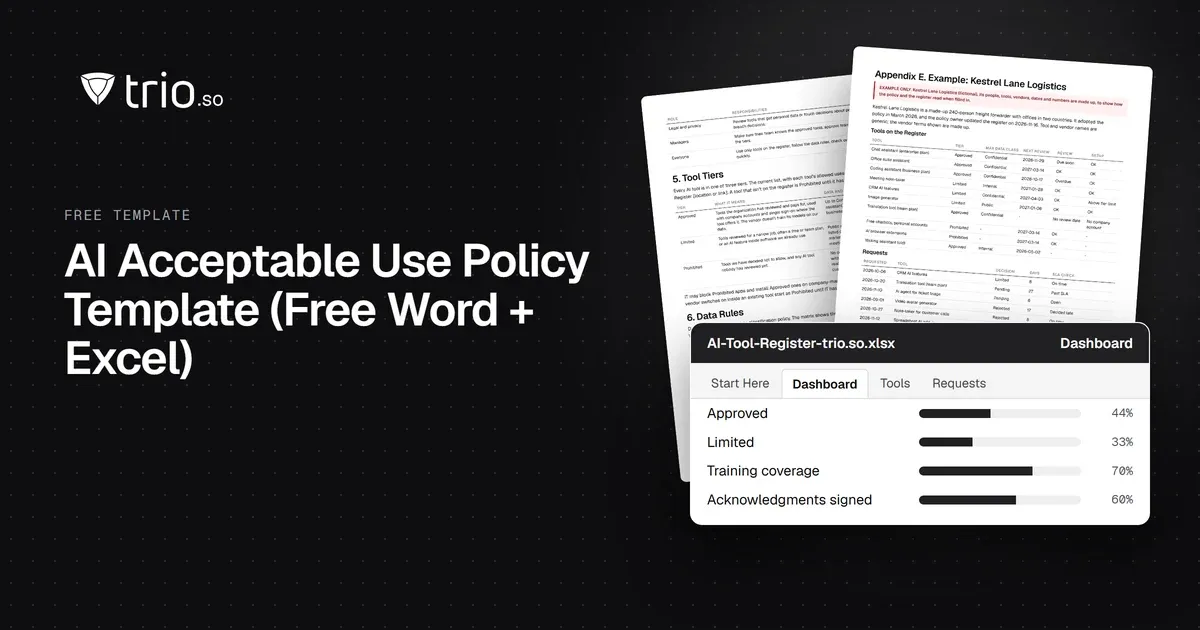
Free AI policy template in Word and PDF: tool tiers, a data matrix, allowed uses by role, AI agents, new-tool reviews and an Excel AI tool register.
School IT support for a team of one to three: where the hours go, what to automate first, a weekly and termly routine, and when to bring in outside help.
How MSPs launch and price a compliance as a service offer: frameworks clients face, packaging, pricing models, evidence and what not to promise.
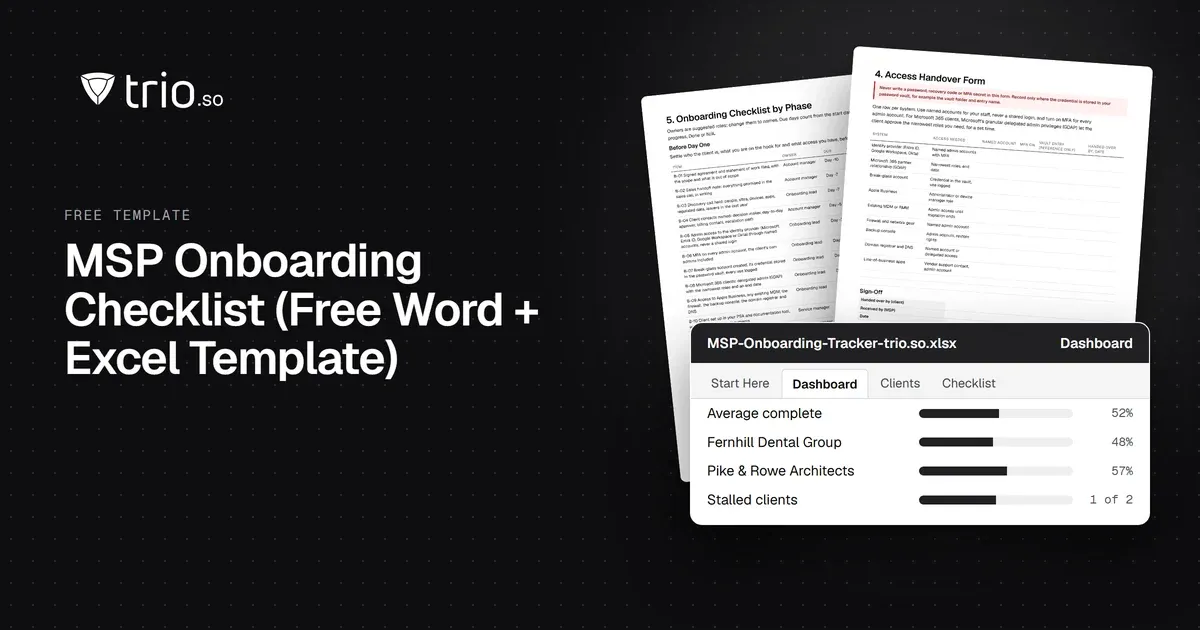
Free MSP onboarding checklist in Word, Excel and PDF: access handover, inventory, enrollment, baseline policies, a security check and offboarding.

Managed IT services for schools: what to outsource, what to keep in house, how providers price it and what to ask before you sign.
NIS2 covers managed service providers across the EU. See when it applies to your MSP, what Germany's law says, and what clients will ask you to show.
How IT should answer the device questions on a cyber insurance questionnaire: honest partial answers, evidence to attach, common mistakes and who signs.
14-day free trial. No credit card required.
trio.so for MSPs: one console, separate clients